
Call Anytime
512-508-8373- ClearedDirect > Blog > Facility Management Guides > Security Management Guides > How to Conduct a Security Risk Assessment for Your Aviation Facility
Blog Details

How to Conduct a Security Risk Assessment for Your Aviation Facility
If you’re managing a commercial terminal facility, you already know—security isn’t static.
Planes take off. Crews rotate. Passengers flow in waves. And somewhere in the middle of all that motion, you’re expected to keep everything secure, compliant, and running on schedule.
This isn’t just about locking doors or checking cameras. In aviation environments, risk moves fast. A minor oversight on the ramp, in a baggage area, or at a gate can ripple across operations and create a serious disruption—or worse, a safety incident.
That’s why a standard checklist won’t cut it here.
Whether you’re overseeing airport facility management, supervising airline ground services, or managing terminal operations, your environment needs a security risk assessment built for movement, layers of access, and constant public interaction.
A security risk assessment for a commercial facility is a structured process that identifies, evaluates, and prioritizes potential threats across terminal zones, ground operations, and restricted areas. For airport environments, this assessment focuses on operational flow, regulatory compliance, and zone-specific vulnerabilities to minimize disruptions and protect assets.
Having said that—this is a broad field and can be expanded into more domains. But we’ll walk through the most important facts and give you some practical guidelines that actually help, particularly in the aviation domain. So give this a read, and walk away with insights you can apply, shall we?
What Makes Security Risk Assessments Different in Aviation Facilities?
Not all security risk assessments are built the same — and if you’re operating in an airport environment, they can’t be. You’re not just managing a building; you’re managing an entire ecosystem of schedules, staff rotations, regulations, and public flow.
That’s exactly why assessments in aviation facilities have to go beyond the basics. What works for a corporate office or warehouse simply won’t hold up in a terminal where one blind spot could mean halted operations or federal scrutiny.
So before you even begin the assessment process, it’s important to understand what makes your environment different — because identifying that difference is what makes the whole strategy work.
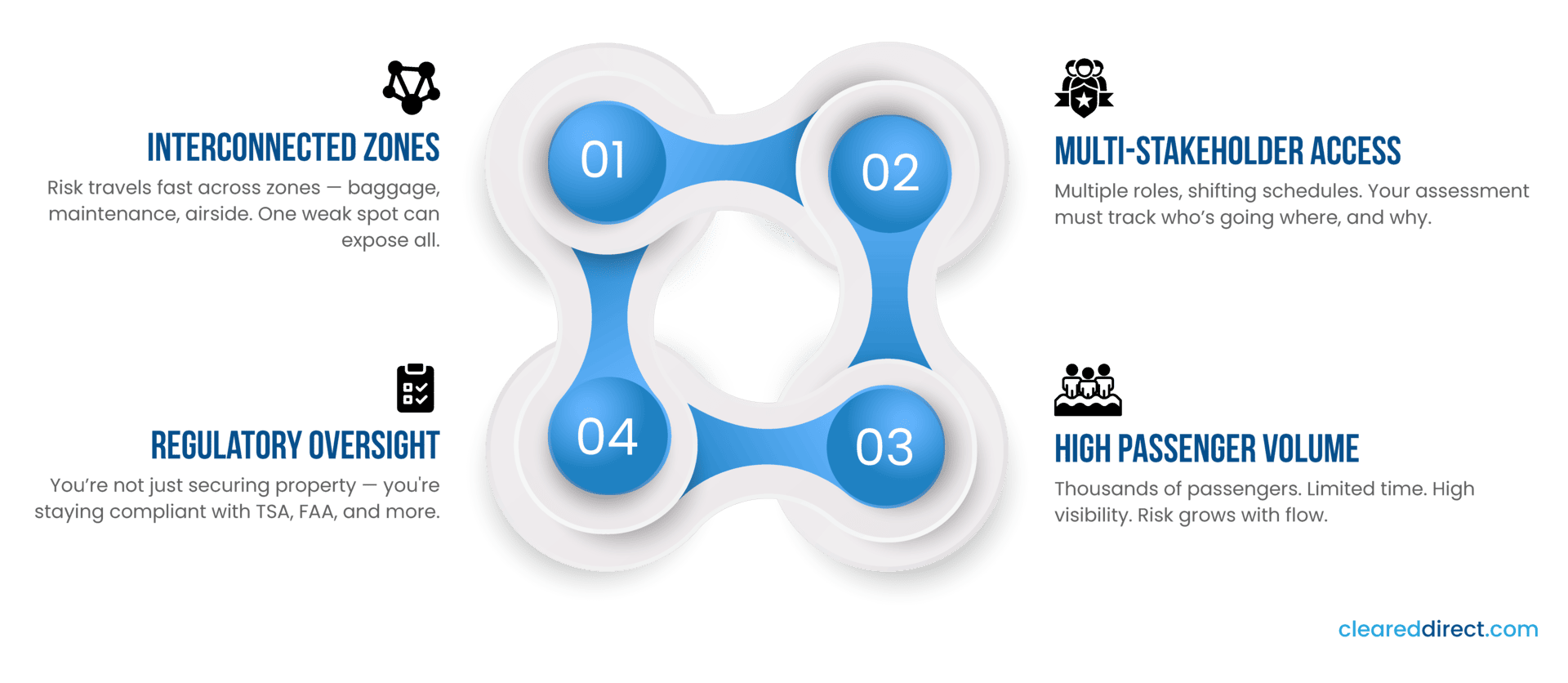
Interconnected Zones with Varying Security Needs
Airports are made up of distinct yet interconnected environments: ticketing areas, concourses, baggage claims, maintenance zones, jet bridges, fuel depots, and loading docks. The challenge? A vulnerability in one area can easily spill into another.
For example, if perimeter security is weak in the maintenance vehicle route, it doesn’t just affect the service yard — it creates potential airside access to active gates. Your assessment must treat the airport as an ecosystem, not a collection of silos.
Diverse Stakeholder Access
Most facilities have a fixed team of employees with controlled access. Airports, on the other hand, see rotating crews, external vendors, contractors, airline employees, baggage handlers, and service technicians — all coming and going, 24/7.
Each group needs different levels of access to different areas — and the timing of that access matters. Your risk assessment has to map who is allowed where, when, and why — because any breakdown in that chain can lead to unauthorized entry or unmonitored movement in critical zones.
Regulatory Oversight
Aviation is one of the most regulated industries in the U.S. — and for good reason. Facility managers must align security risk assessments not just with internal SOPs, but with evolving federal mandates from TSA, FAA, and in some cases, CBP.
Unlike standard commercial buildings that may only reference OSHA or insurance policies, airport facilities face audits, certifications, and compliance documentation that directly impact operational clearance and liability. If your risk assessment doesn’t speak to those standards, it’s not doing its job.
High Passenger Throughput
Most office buildings might see a few hundred people a day. Airports see tens of thousands — often in short bursts of unpredictable flow. Each passenger is a potential risk factor, whether intentional or accidental.
Assessments must factor in real-time crowd density, passenger screening chokepoints, emergency evacuation logistics, and even psychological behavior under stress. A “slow day” in an airport is still busier than peak hours in most other facilities — and that demands a different risk lens entirely.
Did you know?
In 2024, the TSA intercepted 6,678 firearms at airport checkpoints — and 94% of them were loaded. It’s the highest ever recorded, proving how quickly threats can enter aviation environments despite increased awareness.(Business Insider).
Step-by-Step Risk Assessment Framework
A risk assessment in an aviation setting shouldn’t feel like a box-ticking exercise — it should feel like building a real-time safety net around everything you manage. The only way to do that is by tailoring the process to the realities of airport operations: constant movement, layered access, shared responsibilities, and razor-thin margin for error.
This framework gives you a clear and actionable path.
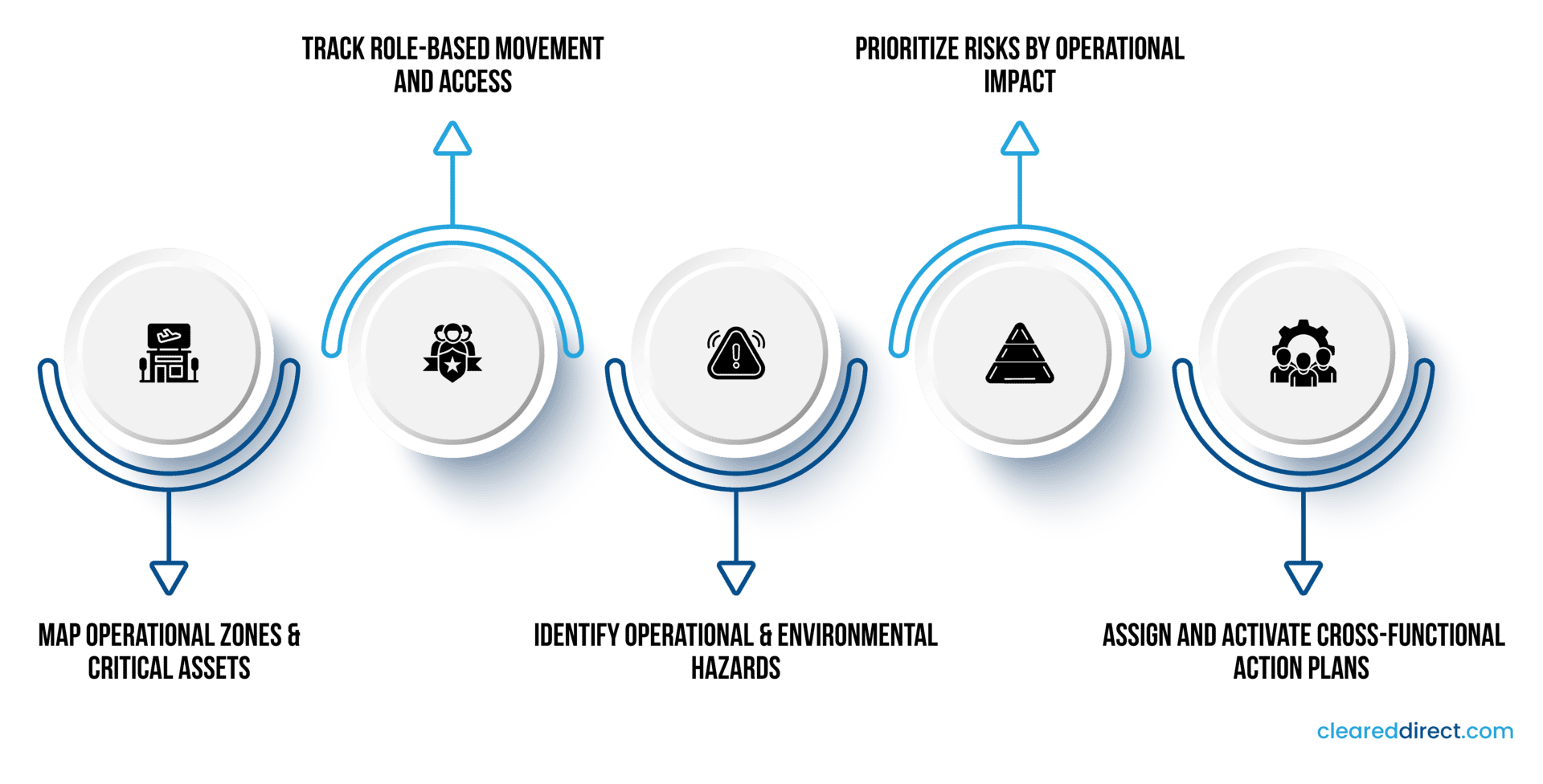
Step 1: Map Operational Zones & Critical Assets
Every assessment starts with clarity. And in an airport, clarity means knowing not just where things are, but how each area ties into operational flow.
You’re not just looking at rooms or gates — you’re mapping function, frequency, and vulnerability.
Start by mapping:
- Passenger-facing zones: Check-in counters, TSA checkpoints, boarding gates, lounges
- Airside operational zones: Aprons, refueling stations, jet bridges, pushback lanes
- Service & support areas: Equipment rooms, utility corridors, staff locker rooms, tunnels
- High-dependency zones: Fuel points, control rooms, back-up power, HVAC zones
- Shared-use zones: Vendor docks, contractor access points, baggage handling areas
Ask yourself:
- Which of these zones, if compromised, would halt a flight or disrupt passenger flow?
- Do any zones serve dual functions (e.g., access corridor for both janitorial and catering teams)?
- Are emergency response teams fully aware of all zones and their operational criticality?
Step 2: Track Role-Based Movement and Access
The greatest security risk isn’t always what comes in — it’s often who’s already inside.
In commercial terminals, the sheer number of stakeholders makes tracking access a challenge. Add third-party vendors, rotating ground staff, and after-hours cleaners — and now your security assessment needs to account for who goes where, when, and why.
Common roles you must track:
- Airline staff: Gate agents, flight crew, maintenance teams
- Airport facility staff: Janitorial, HVAC, operations
- Ground handling crews: Baggage handlers, pushback teams, refuelers
- Contractors: Food service, IT support, cleaning, utilities
- Security & compliance staff: Badge control, camera monitoring, patrols
Questions to guide this step:
- Is each badge tied to a clear, time-limited access level
- What happens when a contractor’s access expires mid-project?
- Are there crossover areas where different teams shouldn’t meet — but often do?
💡
Pro Tip!
Create daily or weekly heatmaps of personnel activity. See who overlaps, where, and whether they’re meant to.
Step 3: Identify Operational & Environmental Hazards
Security risks aren’t limited to breaches or intrusions — especially not in aviation. Many risks lie in routine operations that no one sees coming until it’s too late.
Operational & Environmental Hazards:
- Vehicle collisions in blind corners on the apron
- Ramp congestion during simultaneous boarding and deboarding
- Jet bridge failures due to unreported wear
- Service tunnel doors propped open for “quick runs”
- Rainwater flooding equipment storage
- Extreme heat impacting fuel truck performance
Ask yourself:
- Are these hazards being logged, monitored, and mitigated daily?
- Do your incident reports align with the same zones showing the highest traffic?
Step 4: Prioritize Risks by Operational Impact
This is where most assessments go wrong. Not every “critical” risk on paper is critical in reality.
In airport operations, the most valuable prioritization metric is disruption impact — how a specific threat affects flight schedules, passenger processing, or safety protocols.
Use this prioritization lens:
- High likelihood + high impact = Critical (Immediate action required)
- Low likelihood + high impact = High (Contingency planning needed)
- High likelihood + low impact = Moderate (Monitor & automate response)
- Low likelihood + low impact = Low (Log and revisit periodically)
Questions to ask:
- If this area is compromised, what’s the first domino to fall — and how far does the chain go?
- Would this risk be worse during peak hours or off-hours?
- What’s the PR, financial, or regulatory cost of failure?
Step 5: Assign and Activate Cross-Functional Action Plans
An assessment is only useful if someone acts on it — and in aviation, everyone’s job touches someone else’s outcome.
It’s not enough to say “fix this.” You need named owners, coordinated teams, and deadlines tied to actual risk exposure.
Make sure your plan includes:
- Designated zone owners (by function, not just title)
- Timelines based on real operational urgency, not admin availability
- Pre-scheduled check-ins — especially during seasonal ramp-ups
- Emergency backup assignments in case the primary responder is off-site
Checklist to close this step:
- Is the task assigned?
- Does the assignee have the authority and tools to act?
- Is it documented in your central facility log?
- Is there a review date already scheduled?
Integrating Surveillance, Access Control & Emergency Response in Aviation Facilities
In the dynamic environment of airport operations, ensuring safety isn’t solely about advanced technology—it’s about how effectively surveillance, access control, and emergency response systems work together to support daily functions. For security service providers, the focus is on facilitating seamless coordination among these elements to enhance overall security posture.
Surveillance: Enhancing Situational Awareness
Effective surveillance is pivotal in monitoring airport activities and identifying potential security concerns promptly. By strategically positioning surveillance systems, security teams can:
- Monitor key areas such as terminals, baggage claims, and restricted zones.
- Deter unauthorized activities through visible surveillance presence.
- Provide valuable footage for incident investigations and compliance audits.
In 2024, the Transportation Security Administration (TSA) reported that over 300 individuals attempted to bypass various aspects of airport security in the United States. These incidents highlight the critical role of vigilant surveillance in detecting and preventing unauthorized access.
Access Control: Managing Movement with Precision
Controlling access within airport facilities is essential to maintain security and operational efficiency. According to FAA statistics, 664 pedestrian and vehicular runway incursions occurred from January through May 2024.
Although lower than the number of incidents during the same months in 2023, it demonstrates the ongoing challenge of securing airfields from unauthorized entry. Implementing robust access control measures helps in:
- Ensuring only authorized personnel enter sensitive areas.
- Preventing potential security breaches through unauthorized access.
- Facilitating smooth movement of staff and contractors without compromising security protocols.
By maintaining clear access protocols and regularly updating access permissions, security teams can effectively manage the flow of individuals within the facility.
Emergency Response: Preparedness and Coordination
Being prepared for emergencies is a cornerstone of airport security. Effective emergency response involves:
- Establishing clear communication channels among security personnel, airport staff, and emergency services.
- Conducting regular drills to ensure readiness for various scenarios.
- Developing comprehensive response plans tailored to specific types of incidents.
A well-coordinated emergency response strategy ensures that all stakeholders can act swiftly and effectively when unforeseen events occur.
Common Oversights That Undermine Aviation Risk Assessments
Even the most detailed security risk assessments can fall short — not because of what’s documented, but because of what’s ignored. In airport environments where movement never stops, it’s the overlooked pieces that often cause the biggest disruptions.
The Overnight Blind Spot
Most assessments focus on the obvious: peak hours, passenger surges, gate changes. But what about overnight operations?
Late at night, terminals quiet down — but that’s when janitorial crews arrive, refueling ramps get busier, and low-visibility zones become even harder to track. If your plan assumes that “less activity” means less risk, you’re leaving open gaps no one’s watching.
Entry Points Nobody Talks About
Airports aren’t built like standard facilities. There are tunnel systems, far-off vehicle gates, stairwells, and staff-only entrances that rarely get foot traffic during the day — yet become primary routes after hours or during vendor deliveries.
When these access points aren’t actively monitored or tested in drills, they quietly become your weakest links.
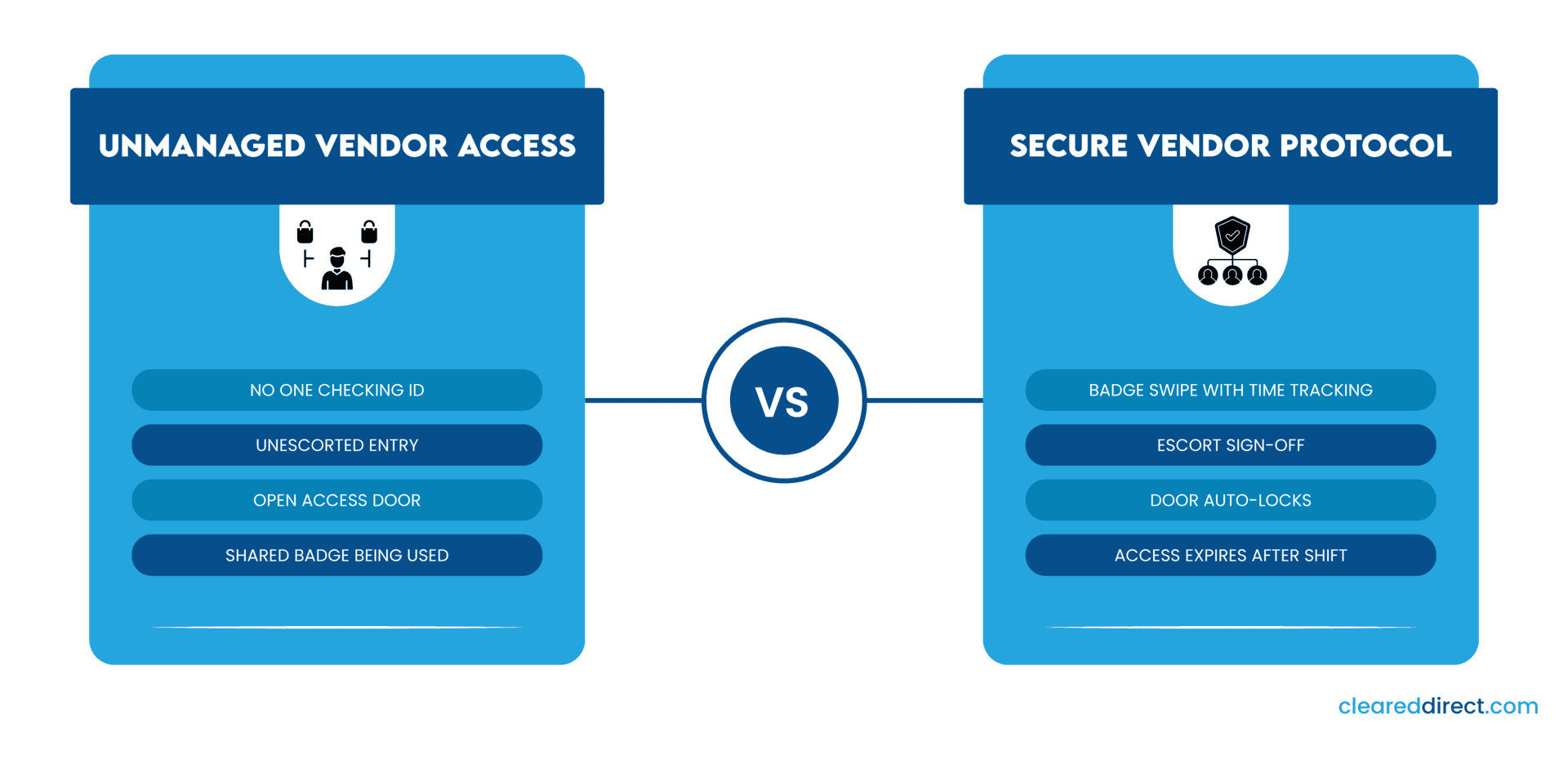
Vendors: Everyone’s Responsibility, No One’s Plan
Catering, custodial, maintenance, IT — airports rely on dozens of third-party providers to function. But when it comes to access, communication, and accountability, contractors often fall through the cracks.
Are badges deactivated when contracts end? Are subcontractors included in drills? Do cleaning teams know who to call when they see a breach? If your answer to any of these is “I think so,” that’s a risk worth flagging.
When Small Failures Spiral
One of the most damaging mistakes in risk planning is treating problems in isolation.
Take a minor delay at a security gate — not a big deal by itself. But if that delay backs up baggage loading, slows fuel delivery, and stalls three departures… suddenly, you’re dealing with operational chaos.
Without evaluating how one risk affects others, your “low priority” issue can quickly become a very public failure.
What a “Good” Risk Assessment Report Looks Like in Aviation
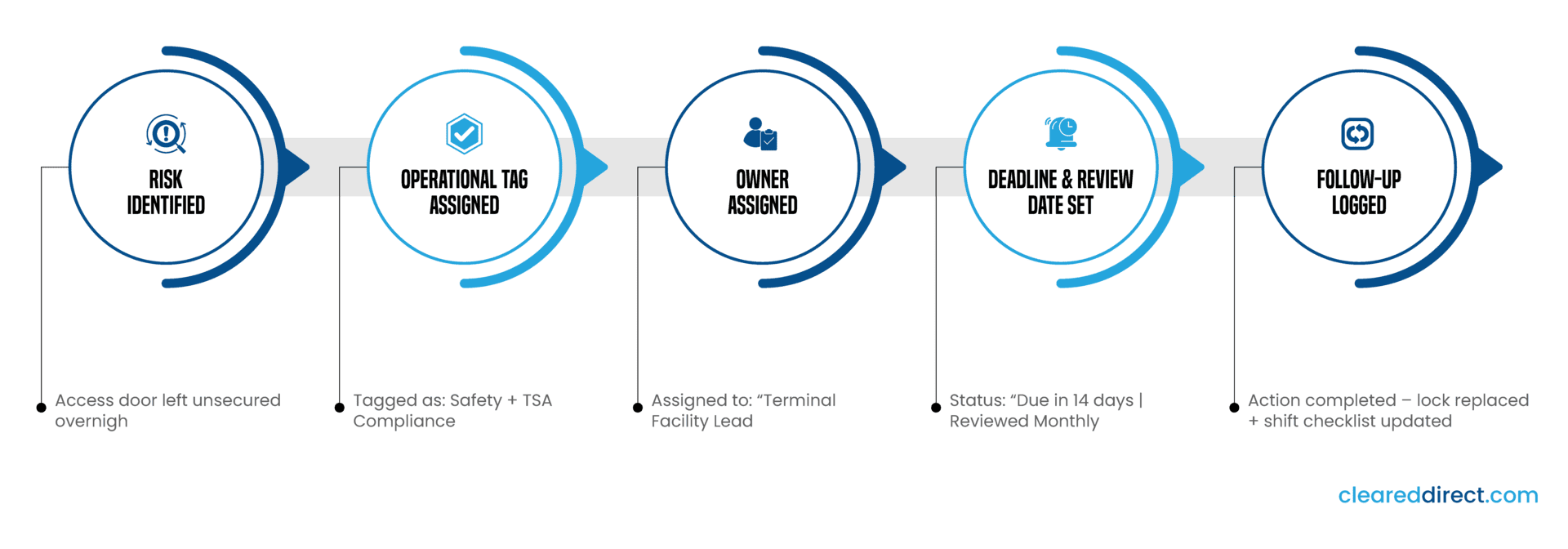
A solid security risk assessment shouldn’t feel like it’s written for a binder — it should feel like it’s built for the people who actually keep the airport running.
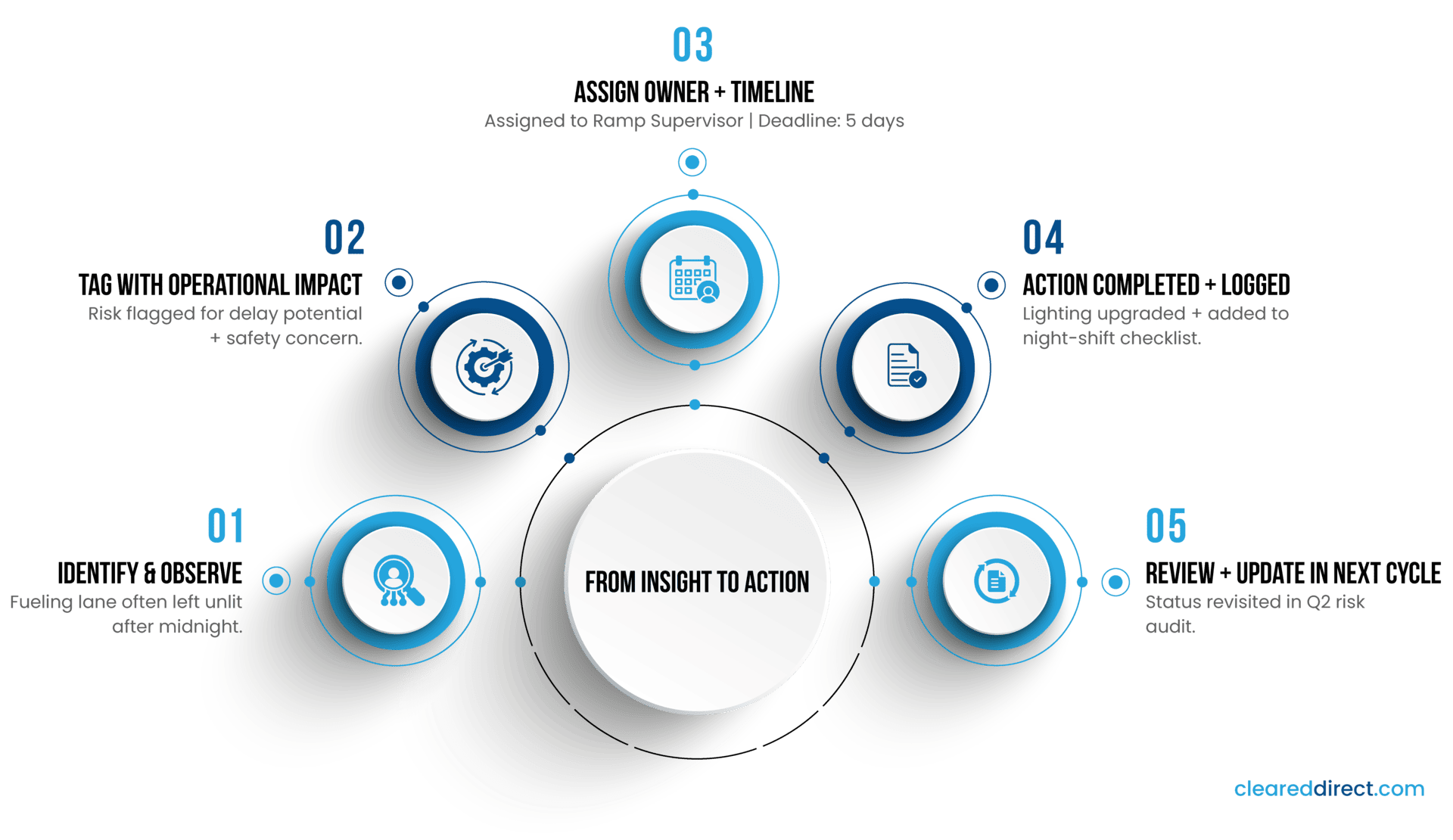
From terminal supervisors to the overnight crew, everyone should be able to glance at it and know what needs attention, why it matters, and who’s handling it. It’s not about flooding teams with data — it’s about giving them the kind of insight they can act on.
A great report doesn’t just tell you what went wrong. It shows you where the issue is, what’s at stake, and how you’re moving forward. That’s how you turn information into accountability — and risk into action.
Landing Thoughts
A strong risk assessment isn’t just about spotting what’s wrong — it’s about helping your team stay one step ahead of it. When done right, it becomes something everyone relies on: not a report for the shelf, but a tool for the field.
It connects your frontline crew, your facility staff, and your leadership team around a shared understanding of where risk lives and what’s being done about it.
This is how to approach it—and this is a ClearedDirect approach.
As a Texas Level II Licensed Security company, ClearedDirect helps aviation facilities close real-world gaps — not just check boxes. We bring hands-on expertise across commercial terminals, airside operations, and airport facility logistics. Our team works directly with yours to uncover blind spots, secure high-traffic areas, and ensure that security protocols aren’t just documented — they’re actively reinforced. Whether you need a full-scale assessment or focused support, we bring clarity and control where safety and timing can’t afford compromise.
Because at the end of the day, real security isn’t about reacting. It’s about being prepared, together.
References:
https://www.vectorsolutions.com/resources/blogs/guide-to-risk-management-in-facilities/
https://www.facilitiesnet.com/facilitiesmanagement/article/6-Steps-to-Conduct-a-Risk-Assessment160--20076
https://www1.wsrb.com/resources/risk-assessment-guide
Tags:

Kevin Milewski
Kevin Milewski is the Chief Operating Officer at ClearedDirect, where he oversees operational strategy, technology implementation, and service delivery for aviation and commercial drone (UAV) projects. With a strong background in aviation services and facility management, Kevin focuses on improving safety, efficiency, and regulatory compliance across complex airport and industrial environments. At ClearedDirect, Kevin leads initiatives integrating drone surveillance, LiDAR imaging, and AI-driven facility inspection systems that help clients achieve higher safety and performance standards. His leadership contributes to the company’s commitment to precision, reliability, and data-driven decision-making in critical infrastructure operations. Kevin regularly contributes insights to ClearedDirect’s knowledge hub, covering UAV surveillance, aviation operations, and facility optimization topics. His work reflects practical industry experience and a dedication to advancing innovation in aviation and technology management. Connect with Kevin on LinkedIn to learn more about his work.
RECENT POSTS


Recent Comments
CATEGORIES
- Aviation Facility Management
- Commercial Cleaning
- Construction
- Digital Mapping & Analytics
- Drone & LiDAR Inspections
- Drone And LiDAR Guides
- Facility Cleaning Resources
- Facility Management Guides
- Facility Management Risk
- Facility Management Technology
- Facility Operations
- Facility Security Management
- Identifying & Eliminating Inefficiencies
- Operations Management Guides
- Process Optimization
- Security Management Guides
- Staffing Augmentation Guides
- Surveillance UAV Drone Guides
- UAV Drone Mapping
- Uncategorized
TAGS
2025 facility trends aerial surveillance aircraft cleaning airline operations airport compliance management airport operational risk management airport personnel airport terminal operations Aviation Operations Aviation Risk Management aviation security risk assessment aviation services AviationStaffing aviation staffing Commercial Cleaning Services Commercial Drone Surveillance Commercial Facility Security Drone Surveying Emergency Response Planning Facility Hygiene Compliance facility maintenance facility management Facility Risk Assessment Facility risk management facility services Green Cleaning for Facilities ground handling services integrated facility management services Operational Efficiency Strategies operations management outsource facility management outsourcing airline services outsourcing airport services passenger experience enhancement Physical Security Best Practices proactive maintenance Scaling janitorial operations seasonal peaks staff augmentation Staffing Augmentation Staffing Challenges Aviation terminal facility security TSA FAA risk mitigation uav infrastructure inspection uav lidar technology
Leave a Comment