
Call Anytime
512-508-8373- ClearedDirect > Blog > Facility Management Guides > Facility Cleaning Resources > Why Enterprise Retail Stores Struggle With Cleanliness—and How a Cleaning Checklist Solves It
Blog Details

Why Enterprise Retail Stores Struggle With Cleanliness—and How a Cleaning Checklist Solves It
Cleanliness has a larger impact on the customer experience than many retailers account for. Shoppers may not comment on spotless floors or streak-free glass, but they quickly notice when those details are missing.
A cluttered counter or dirty restroom doesn’t just look bad—it affects how long customers stay, how comfortable they feel, and how they view the brand. Clean stores communicate professionalism, while unclean ones quietly suggest neglect.
The challenge is rarely about intent.
Most staff members care about maintaining a clean space, and most managers understand how it affects store performance. But without a clear system in place, tasks are often handled reactively. Some areas get cleaned multiple times a day, while others are forgotten entirely. During busy hours, it becomes easy for teams to focus only on the most visible messes and ignore the rest. That’s where a structured retail cleaning checklist makes a measurable difference.
Retail stores struggle with cleanliness because their routines are inconsistent, undocumented, and difficult to track. Without a clear checklist, cleaning becomes uneven, and high-traffic areas are often missed. A retail cleaning checklist solves this by turning cleaning into a repeatable process with defined responsibilities and timing.
With a consistent routine in place, retail space cleaning becomes more manageable—no matter how busy the day gets.
What Causes Inconsistent Retail Cleaning—and How to Fix It
When Cleaning Is Everyone’s Job, It Becomes Nobody’s Priority
In most retail stores, cleaning is considered a shared task. But shared responsibility without clear direction usually leads to uneven results. Everyone means to help, but no one knows exactly what to do or when to do it. Staff members are pulled in multiple directions—ringing up customers, restocking shelves, assisting with returns—and cleaning gets squeezed into whatever moments are left.
This often leads to surface-level effort. One shift might clean the glass doors, but forget the checkout counter. Another might tidy the floor but skip the fitting rooms. Without a checklist or rotation, retail cleaning becomes reactive. It depends on what’s visible, not what’s necessary.
Busy Stores Move Fast—But Dirt Builds Slowly
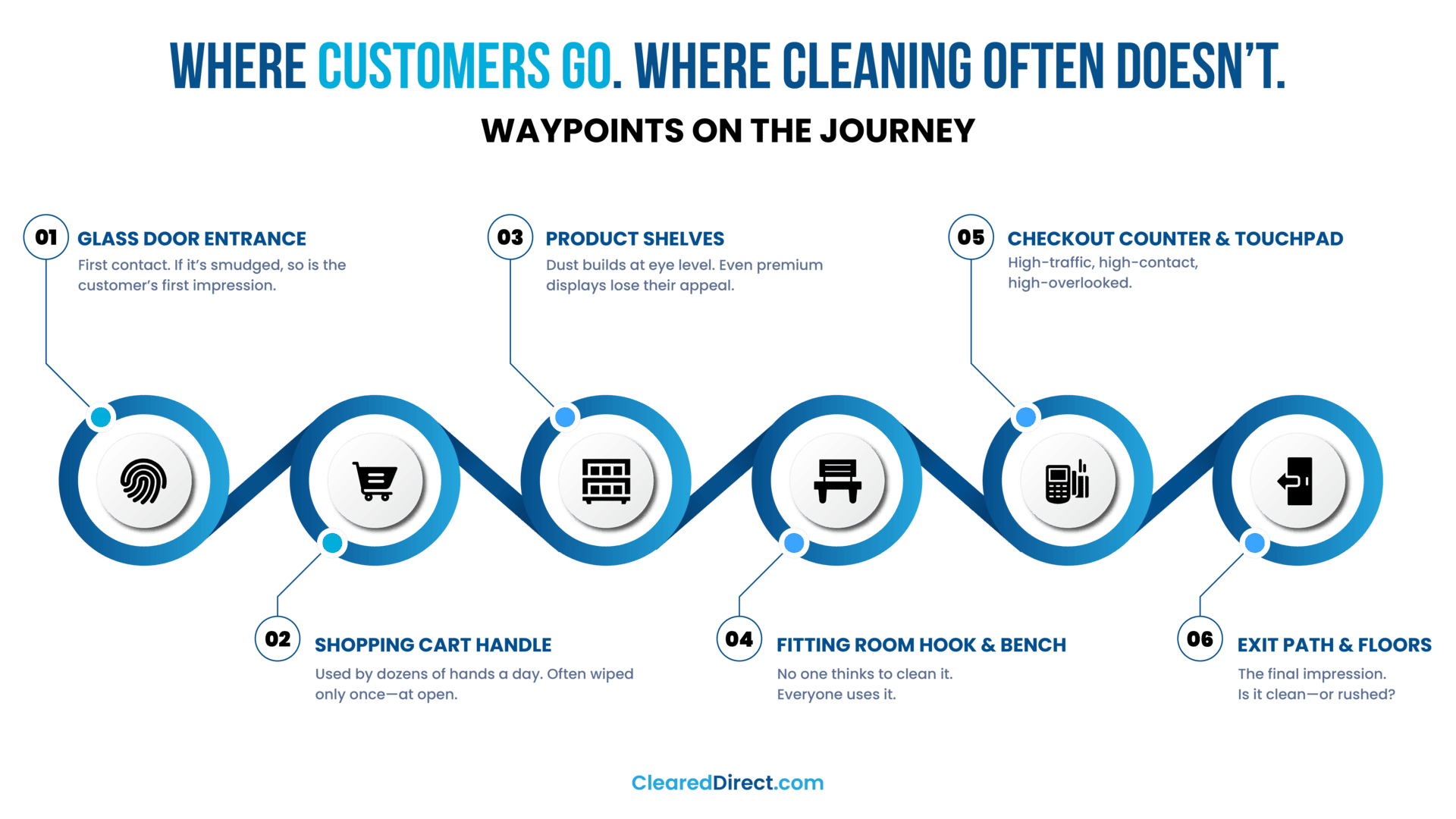
The pace of retail rarely slows down. Stores can go from quiet to packed in minutes, and when they do, cleaning becomes an afterthought. Most messes don’t appear all at once—they build up quietly. A sticky cart handle. Dust on a shelf edge. Smudges on a touchscreen. Customers notice these things, even if staff are too busy to stop and clean them right away.
In larger commercial retail stores, the issue grows. More square footage means more surfaces, more zones, and more opportunities for things to be missed. Without a process in place—especially one tied to a formal retail commercial cleaning schedule—it’s easy for high-touch areas to go unchecked for hours.
💡
Pro Tip!
Don’t wait until something looks dirty. Some of the most-used surfaces—like fitting room hooks or breakroom handles—don’t show grime right away but should still be cleaned frequently.
How a Retail Cleaning Checklist Solves the Problem
Imagine Two Stores. Same Day. Same Team Size. Completely Different Results.
At 9:00 AM, both stores unlock their doors. Both are moderately busy. Both have staff who care about doing a good job. But only one of them starts the day with a checklist.
Store A: No Checklist
- Carts were sanitized in the morning. That’s the last time anyone touched them.
- By lunch, the checkout station is covered in fingerprints. No one’s cleaned it.
- Restrooms haven’t been checked since opening. The trash is nearly full.
- Fitting room hooks? No one’s even thought about them.
It’s not that the team doesn’t care. They’re just moving too fast—and there’s no system to guide them.
Store B: Using a Retail Cleaning Checklist
- Every staff member knows their assigned zone.
- The morning checklist includes carts, glass doors, and shelf edges.
- Mid-shift touchpoints are cleaned and logged—quickly, without disrupting workflow.
- Restrooms and fitting rooms are on rotation. Nothing is left to chance.
This isn’t about cleaning more. It’s about knowing what to clean and when.
So What’s the Fix? Not More Reminders—Just a Better Process
A retail cleaning checklist replaces guesswork with routine. It gives every staff member clear steps to follow, no matter how busy the store gets. No more assuming someone else handled it. No more cleaning the same thing twice while another area is forgotten.
Unlike ad hoc methods, a structured retail cleaning service doesn’t rely on memory. It relies on process. That same mindset—when applied internally—creates consistency that scales, even in high-traffic commercial stores with multiple departments and shifts.
Learn More in our detailed guide on commercial cleaning services, including janitorial, deep cleans, and fogging technologies.
What to Include in an Effective Retail Cleaning Checklist
A retail cleaning checklist is not just a task list—it’s a structure that helps teams clean with purpose, not guesswork.
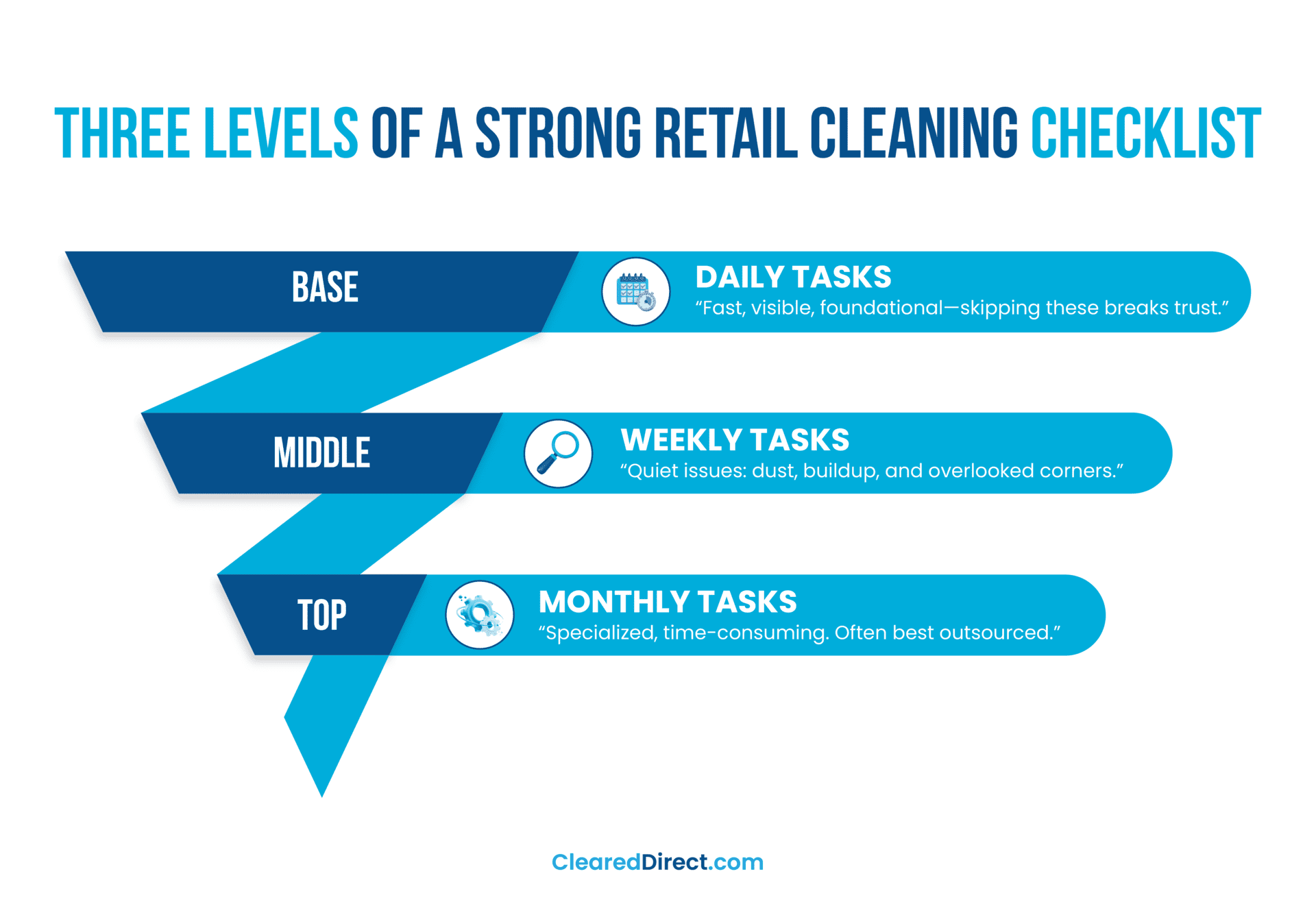
When cleaning duties are grouped by how often they need to be done, the work becomes more manageable and much easier to maintain across shifts. It also helps managers spot patterns: What’s getting missed? What always gets delayed? What never gets done at all?
Cleaning by frequency is one of the simplest ways to stay consistent, especially in fast-moving retail environments. As outlined in this ISSA guide on cleaning schedules and frequency-based protocols, assigning tasks by timing—not just location—helps prevent oversights and improves efficiency. Below, we’ll look at the three core layers: daily, weekly, and monthly. Each one plays a different role in shaping the customer experience in the US—and each one signals when it might be time to bring in outside help.
The Daily Layer: High-Frequency, High-Visibility
Daily cleaning covers the tasks that directly shape how a customer feels the moment they walk in. If carts are sticky, mirrors are streaked, or restrooms are poorly stocked, trust erodes quickly—sometimes without a word being said.
This layer typically includes basic floor care, surface disinfection, restroom upkeep, and tidying high-touch areas like checkout counters or fitting rooms. If your store struggles with this tier, it’s not a cleaning issue—it’s a workflow issue. The list is short, but it needs to happen without fail.
A reliable retail cleaning routine starts here. When the basics are done consistently, the rest of the store feels in order.
The Weekly Layer: Quiet Accumulators
Weekly tasks are easy to overlook because their effects build slowly. Dust on signage. Debris under shelves. Smudges around the fitting room mirror. Customers may not notice them immediately, but when they do, it often feels like something has been off for a while.
This layer includes light fixture dusting, shelf cleaning, fitting room refreshes, and deeper restroom sanitization. These items often fall off the radar when teams are rushed—but they’re essential to presentation and perception.
If weekly tasks are repeatedly skipped, your checklist might be too long—or your team might need clearer task ownership.
The Monthly Layer: Where Time Runs Out
This is where things get tough. Deep cleaning, specialty floor care, appliance sanitation—these tasks take time, tools, and focus. Most internal teams know they need to happen, but they rarely have the capacity to do them well.
That’s where a retail cleaning service becomes useful. Not because your team isn’t capable, but because time and tools are limited. When deep cleans keep getting pushed off the list, outsourcing is not a failure—it’s a fix.
And this isn’t just for large chains. Even in a single-location commercial store, professional support can make a noticeable difference in cleanliness, morale, and consistency.
Common Mistakes That Undermine Retail Cleaning Checklists
The biggest problem with cleaning checklists? Most stores think they have one that works—until they start looking closely. A laminated page on the backroom wall, a handwritten list by the restroom sink, or a spreadsheet no one updates anymore. These are all examples of a system that exists in theory, but not in practice.
Even well-organized stores fall into patterns that make their retail cleaning checklist more confusing than helpful. The result? Inconsistent results, missed tasks, and frustrated staff who want to do their job well but aren’t given the right structure to do it.
Let’s break down what that looks like in real life—and how to fix it.
The Checklist That’s Too Vague to Work
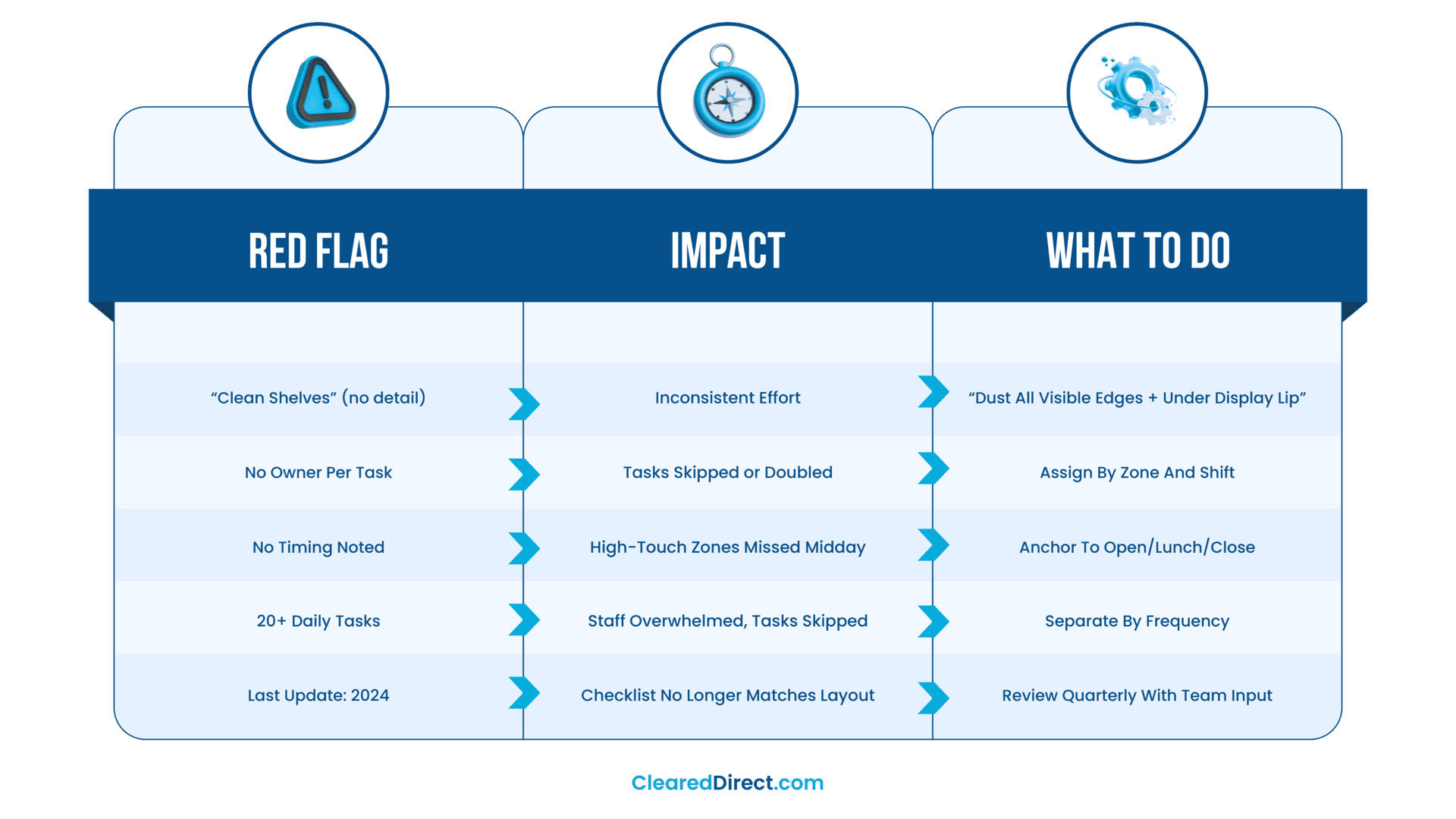
Imagine a team member is told to “clean the checkout area.” Do they wipe down the entire counter? The POS terminal? The bagging surface? The answer varies depending on who’s working.
Without specific instructions, even experienced staff will make assumptions—and assumptions lead to gaps.
Fix it: Rewrite vague tasks into clear, action-oriented lines. “Wipe and disinfect touchscreen + card reader” leaves no ambiguity.
The List That’s Always There—But Never Used
A common issue in larger commercial retail settings is visibility without follow-through. The checklist is printed, but no one signs off. Or it’s completed all at once just before closing, defeating the purpose of frequency-based tasks.
In short: it’s decoration, not documentation.
Fix it: Tie checklist tasks to actual shift flow (e.g., “mid-shift restroom check”) and assign ownership. A list that lives in motion gets used. One that just lives on the wall gets ignored.
The Checklist That Outgrew the Team
Over time, stores expand their list without adjusting for bandwidth. One store had over 30 items on a single daily list, ranging from cart sanitation to wiping stockroom light switches. Staff started skipping tasks silently, just to get through the shift.
This isn’t a discipline problem. It’s a design problem.
Fix it: Prioritize your retail cleaning checklist by frequency and zone. Break tasks into manageable chunks. What must happen daily? What can shift to weekly? What’s better handled by a retail cleaning partner?
💡
Pro Tip!
A checklist isn’t just a list. It’s a contract between expectations and reality. Make sure yours works for the store you have—not the one you imagined when you first created it.
Why Clean Stores Drive Better Customer Experience
Retail Space Cleaning Builds Trust Without Saying a Word
Customers form impressions the moment they step inside. Whether it’s a spotless entrance or a tidy checkout area, visual cues tell people what to expect—not just about the space, but about the brand. Clean stores suggest care, professionalism, and attention to detail. Messy ones suggest the opposite.
That’s why retail space cleaning is not just about hygiene—it’s about customer confidence. Shoppers tend to stay longer, browse more, and return more often when a space feels clean. And even if they don’t say so directly, their behavior reflects it. Higher dwell time, fewer complaints, and stronger in-store conversions are often tied to clean, well-maintained environments.
Retail Cleaning Routines That Support Real Business Outcomes
What drives that consistency? Structure. Stores that rely on memory or best guesses tend to overlook the same areas again and again. In contrast, a clear retail cleaning routine builds repeatable habits that improve performance over time. Clean mirrors, sanitized POS systems, and dust-free shelves don’t just happen—they’re the result of systems that work.
This becomes even more important at scale. In retail commercial cleaning, consistent outcomes across multiple locations mean stronger brand alignment, fewer negative reviews, and easier store management. A well-designed retail cleaning checklist ensures that no zone is neglected, and every task is documented—regardless of who’s on shift.
Conclusion
Cleanliness doesn’t need to be complicated—but it does need to be consistent. That’s what separates retail stores that look polished every day from those that only look presentable once in a while. The difference isn’t just in effort—it’s in the system behind it.
A well-structured retail cleaning checklist helps your team stay aligned, your store stay ready, and your customers stay confident in your brand. It creates visibility, accountability, and repeatable routines across every shift, surface, and square foot.
But if keeping up with that consistency has become a challenge—whether it’s due to limited staff, growing square footage, or recurring maintenance gaps—we can help.
ClearedDirect specializes in supporting retail teams with reliable, scheduled cleaning services that adapt to your store’s layout, traffic patterns, and operational flow. From daily support to monthly deep cleans, we make sure your standards are maintained—even when your internal team is stretched thin.
If you’re ready to bring consistency back to your cleaning program, reach out to us. We’ll help you turn structure into results—and every first impression into a lasting one.
Tags:

Kevin Milewski
Kevin Milewski is the Chief Operating Officer at ClearedDirect, where he oversees operational strategy, technology implementation, and service delivery for aviation and commercial drone (UAV) projects. With a strong background in aviation services and facility management, Kevin focuses on improving safety, efficiency, and regulatory compliance across complex airport and industrial environments. At ClearedDirect, Kevin leads initiatives integrating drone surveillance, LiDAR imaging, and AI-driven facility inspection systems that help clients achieve higher safety and performance standards. His leadership contributes to the company’s commitment to precision, reliability, and data-driven decision-making in critical infrastructure operations. Kevin regularly contributes insights to ClearedDirect’s knowledge hub, covering UAV surveillance, aviation operations, and facility optimization topics. His work reflects practical industry experience and a dedication to advancing innovation in aviation and technology management. Connect with Kevin on LinkedIn to learn more about his work.
RECENT POSTS


Recent Comments
CATEGORIES
- Aviation Facility Management
- Commercial Cleaning
- Construction
- Digital Mapping & Analytics
- Drone & LiDAR Inspections
- Drone And LiDAR Guides
- Facility Cleaning Resources
- Facility Management Guides
- Facility Management Risk
- Facility Management Technology
- Facility Operations
- Facility Security Management
- Identifying & Eliminating Inefficiencies
- Operations Management Guides
- Process Optimization
- Security Management Guides
- Staffing Augmentation Guides
- Surveillance UAV Drone Guides
- UAV Drone Mapping
- Uncategorized
TAGS
2025 facility trends aerial surveillance aircraft cleaning airline operations airport compliance management airport operational risk management airport personnel airport terminal operations Aviation Operations Aviation Risk Management aviation security risk assessment aviation services AviationStaffing aviation staffing Commercial Cleaning Services Commercial Drone Surveillance Commercial Facility Security Drone Surveying Emergency Response Planning Facility Hygiene Compliance facility maintenance facility management Facility Risk Assessment Facility risk management facility services Green Cleaning for Facilities ground handling services integrated facility management services Operational Efficiency Strategies operations management outsource facility management outsourcing airline services outsourcing airport services passenger experience enhancement Physical Security Best Practices proactive maintenance Scaling janitorial operations seasonal peaks staff augmentation Staffing Augmentation Staffing Challenges Aviation terminal facility security TSA FAA risk mitigation uav infrastructure inspection uav lidar technology
Leave a Comment