
Call Anytime
512-508-8373- ClearedDirect > Blog > Drone And LiDAR Guides > Surveillance UAV Drone Guides > A Guide to Commercial Drone Surveillance: Understanding FAA Rules & Best Practices
Blog Details

A Guide to Commercial Drone Surveillance: Understanding FAA Rules & Best Practices
Ever wonder what really happens behind the scenes when a drone is used for surveillance at a job site, facility, or event? It’s more than just a flying camera—it’s a regulated aircraft. And if you’re using one for business, you’re expected to follow strict federal rules, even if the drone itself seems simple to operate.
As more industries adopt commercial drones for security, inspections, and operational monitoring, many teams are surprised to learn how quickly they fall under the FAA’s radar. Flying for business means you’re bound by drone compliance standards that go far beyond casual use—covering everything from pilot certification to live broadcasting requirements.
Basically, commercial drone surveillance refers to the use of unmanned aircraft systems (UAS) to capture data or video for business purposes and must follow FAA Part 107 regulations. These include having a licensed remote pilot, flying below 400 feet, maintaining visual line of sight, and complying with Remote ID rules.
In this guide, we’ll break down exactly what you need to know—without the legal jargon. From FAA rules to flight best practices, you’ll learn how to operate surveillance drones legally, confidently, and with full awareness of what’s expected.
What Is Commercial Drone Surveillance?
Not all drone flights are treated the same under the law—and the difference comes down to purpose. Flying a drone to film your backyard for fun is one thing. But flying that same drone to monitor a job site, inspect a roof for a client, or scan a property perimeter? That puts you in a different category altogether.
The FAA draws a clear line between recreational flying and commercial drone operations. The moment you’re using a drone to support business activities—whether you’re earning revenue or simply gathering footage as part of your job—you’re expected to follow commercial drone laws. That includes proper licensing, operational restrictions, and full drone compliance with federal rules.
Today, commercial drones are used across a wide range of industries. Construction firms use them for aerial progress updates. Security teams rely on them to monitor large facilities. Utility companies deploy them for infrastructure inspections. And real estate, agriculture, logistics, and public safety teams are quickly following suit.
What triggers FAA enforcement isn’t always obvious. Even unpaid or internal drone work—like capturing footage for a project update or inspecting damage—can be considered “commercial use.” If a drone is contributing to your business in any way, the rules apply.
Does the FAA Regulate Surveillance Drones?
Yes—if you’re flying a drone for surveillance in a commercial context, you’re under FAA regulation. In fact, every surveillance flight that supports a business or organization falls within FAA jurisdiction and must follow a clear set of rules under Part 107.
While many drone operators focus on features like camera quality or battery life, the FAA’s primary concern is airspace safety. That’s why compliance isn’t optional—it’s a legal obligation.
Understanding the FAA’s Role in Commercial Drone Operations
The FAA (Federal Aviation Administration) governs all aspects of unmanned aircraft systems (UAS) used for commercial purposes in the U.S. That includes not just large drones, but even compact surveillance models used on construction sites, for security patrols, or property inspections.
Why does this matter? Because any surveillance flight—even one taking place on private property—still occurs in national airspace. Failing to follow FAA rules can result in fines, license suspension, or denied insurance claims in the event of an incident.
Whether you’re capturing routine footage or conducting real-time surveillance, you’re expected to follow Part 107 drone rules and obtain the appropriate FAA drone license if you’re the pilot in command.
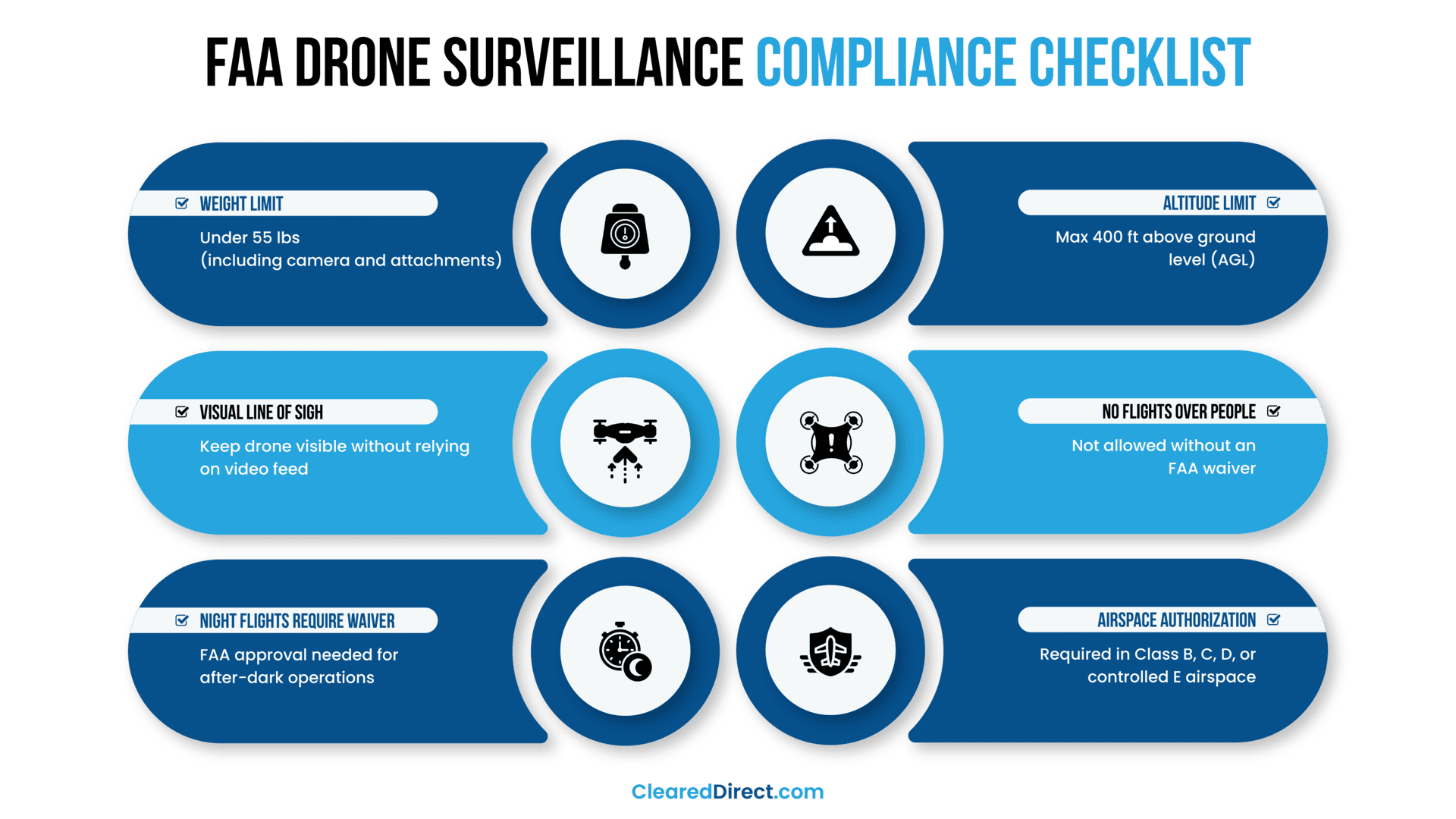
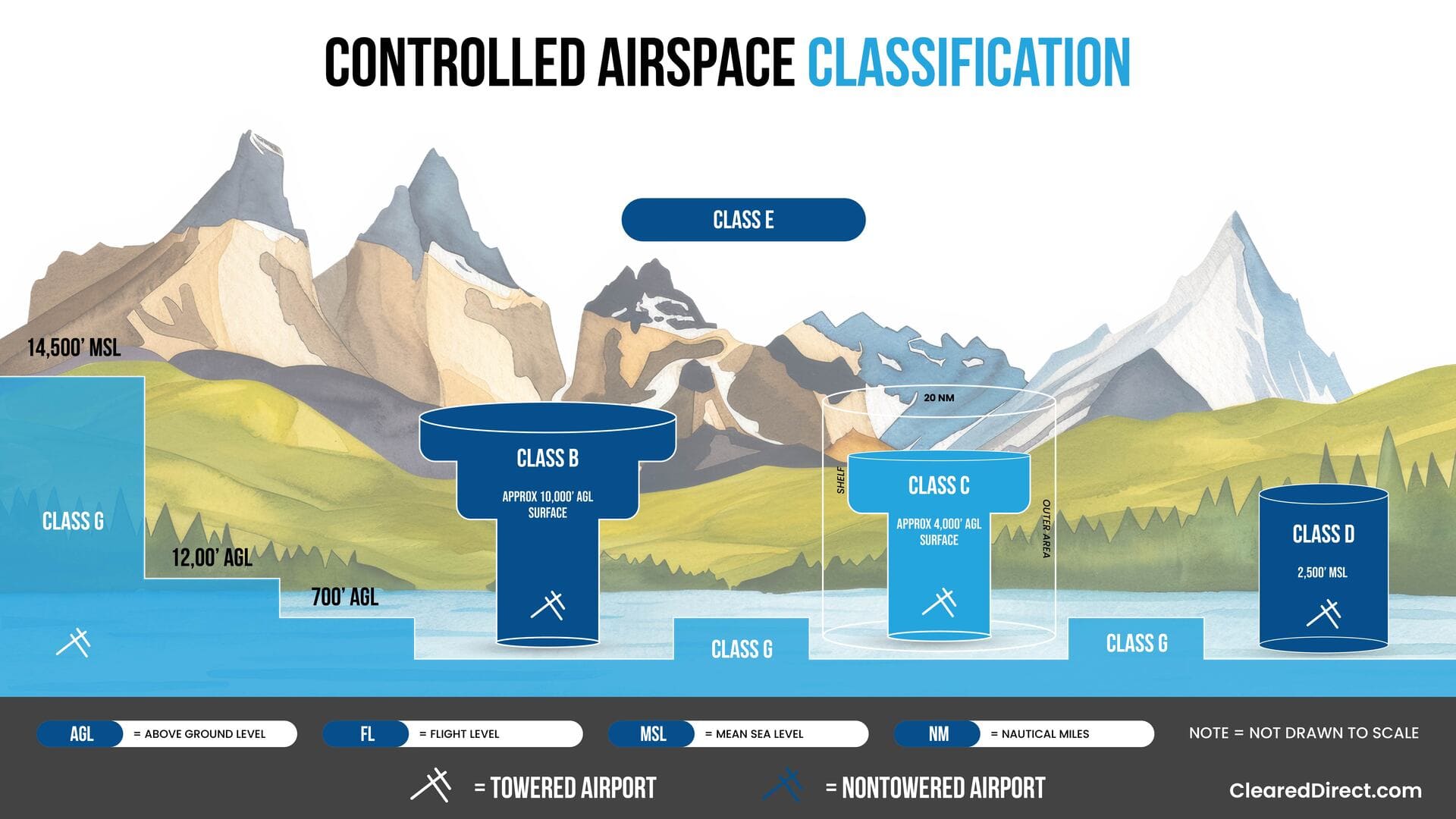
It’s important to talk about controlled airspace, so let’s break it down. These are zones where air traffic control (ATC) services are active, and if you’re flying under Part 107, you’ll need FAA authorization to operate here.
What License Do You Need for Surveillance with Commercial Drones?
Before you can legally fly a drone for surveillance, inspections, or any other business-related task, you need more than just flying skills—you need certification. The FAA requires anyone operating a drone commercially to hold a Remote Pilot Certificate under Part 107 of the Federal Aviation Regulations.
This isn’t just paperwork. It’s your official FAA drone license, and it confirms that you understand the national airspace system, drone safety, and how to fly responsibly under real-world conditions.
Who’s Eligible for a Commercial Drone License?
To apply for your commercial drone license, you must meet the following requirements:
- Be at least 16 years old
- Be able to read, write, and speak English fluently
- Pass a TSA security background check
These eligibility criteria are designed to ensure that certified drone pilots understand flight safety and can be held accountable for how they operate.
What’s on the Part 107 Exam—and When Does It Expire?
To get certified, you’ll need to pass the FAA Part 107 exam, a 60-question multiple-choice test taken in person at an FAA-authorized testing center.
Topics covered include:
- Airspace classifications
- Weather effects on drone flight
- Emergency procedures
- FAA regulations and drone limitations
- Radio communication procedures
- Airport operations
- Drone performance and loading
Once you pass, your certificate is valid for two years. After that, you’ll need to complete a free online recurrent training course on the FAA’s website to stay current and maintain your authority to operate.
Understanding Remote ID: A Must for Drone Compliance
Think of Remote ID as the drone industry’s version of a digital license plate. It allows law enforcement, regulators, and the FAA to identify drones while they’re flying—especially in commercial use cases like surveillance, inspections, or public safety work.
If you’re operating under commercial drone regulations, Remote ID isn’t optional—it’s part of your legal responsibility as a pilot.
What Is Remote ID and Why It Matters
Remote ID is a system that broadcasts identifying information from a drone in real time, including:
- Drone serial number or session ID
- Drone’s location and altitude
- Control station location
- Timestamped flight data
This information helps the FAA monitor drone compliance, improves airspace safety, and allows public officials to respond to unauthorized or unsafe drone activity. For surveillance operators, it adds a layer of accountability—especially when flying near buildings, infrastructure, or sensitive areas.
Who Needs to Comply With Remote ID?
Most commercial drones must comply with Remote ID unless they’re flying in special FAA-approved zones.
Your path to compliance depends on the type of drone you use and where you plan to fly:
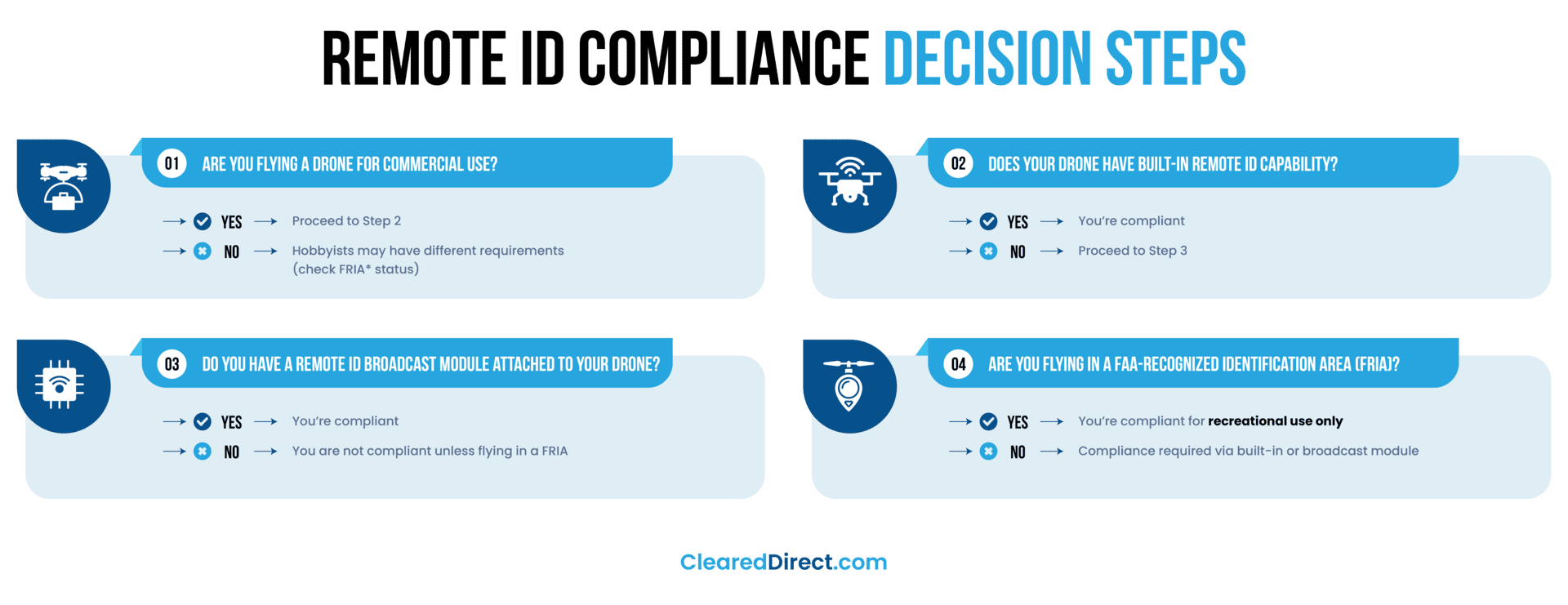
- Built-in Remote ID: Many newer drones (especially DJI enterprise models) come with built-in broadcasting features and are already Remote ID–enabled.
- Broadcast Module: If your drone doesn’t have built-in Remote ID, you can attach an external module that meets FAA standards.
- FAA-Recognized Identification Area (FRIA): You can only fly without Remote ID if you’re in a FRIA—these are limited to community-based organizations and educational institutions, not commercial use.
Can I Fly My Surveillance Drone Beyond Standard Limits?
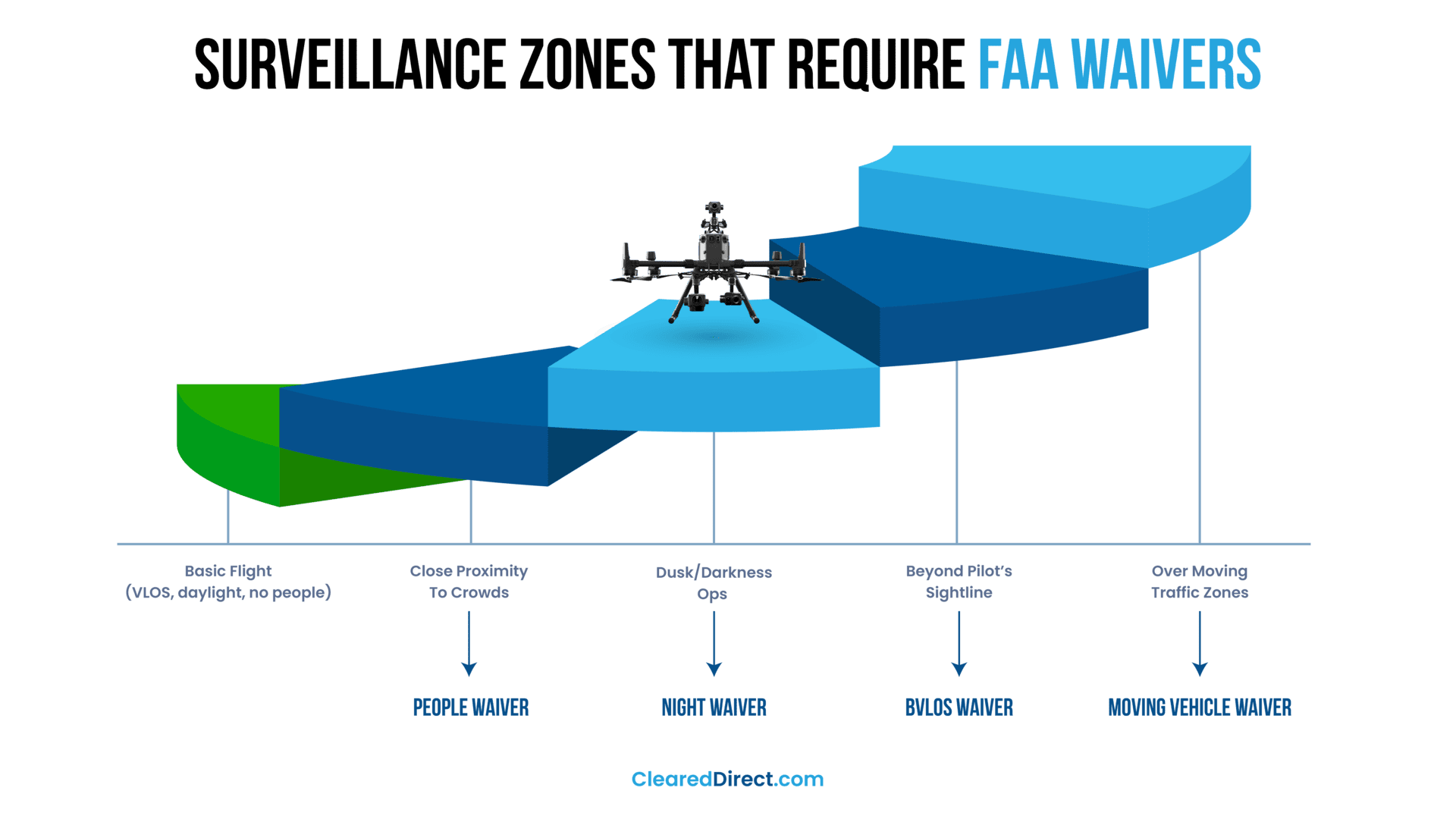
You can—but not without the FAA’s sign-off. Surveillance missions don’t always fit neatly inside the box of standard flight rules. Maybe you need to fly at night for security patrols, or beyond your line of sight to monitor a sprawling facility. Or perhaps you’re covering a live event where people and moving vehicles are everywhere.
In all of these cases, the FAA classifies your operation as “advanced,” which means it’s outside the basic permissions of Part 107 drone rules. To fly this way legally, you’ll need a waiver—and getting one isn’t just about filling out a form.
The FAA wants to know exactly how you plan to manage the risks. Will you use visual observers for BVLOS? Install anti-collision lights for night flights? Restrict your airspace with geofencing? These details matter. Without them, your request won’t get far.
Applications are submitted through the FAA DroneZone portal, and processing times can vary—but expect it to take a few weeks. And the stronger your safety case, the better your chances.
Best Practices for Operating Commercial Surveillance Drones Safely
Running a commercial drone operation isn’t just about hitting records—it’s about building trust, following the rules, and showing you take safety seriously. Here’s how to make sure your surveillance flights meet the mark every time.
Always Start with a Pre-Flight Check
Before takeoff, take a minute to inspect your drone. Check the propellers, battery level, GPS connection, and Remote ID. It doesn’t take long, but skipping this step can lead to equipment failure—or worse, non-compliance. If you’re flying under an FAA drone license, pre-flight checks are expected as part of your routine.
Know the Airspace You’re In
Commercial drone flights are often launched from busy or sensitive areas. Whether you’re surveying a job site or filming a perimeter, check for nearby airports, hospitals, or special event zones. If you’re flying in a fast-growing area like Austin, these restrictions can change quickly, and staying updated is part of staying compliant.
Keep a Record of Every Flight
Maintain flight logs, especially if you’re managing a team or operating under contracts. Track dates, flight paths, mission purpose, and any unusual occurrences. It’s not just helpful for internal reviews—it shows you’re serious about drone compliance if questions ever come up.
Handle Your Footage Responsibly
Surveillance work often captures more than just buildings—it can include people, license plates, or private property. Even if you’re flying legally, what you do with that footage matters. Follow clear data handling policies, and refer to resources like the NTIA’s drone privacy guidelines to stay ahead of privacy concerns.
State & Local Laws That Affect Surveillance Drone Flights
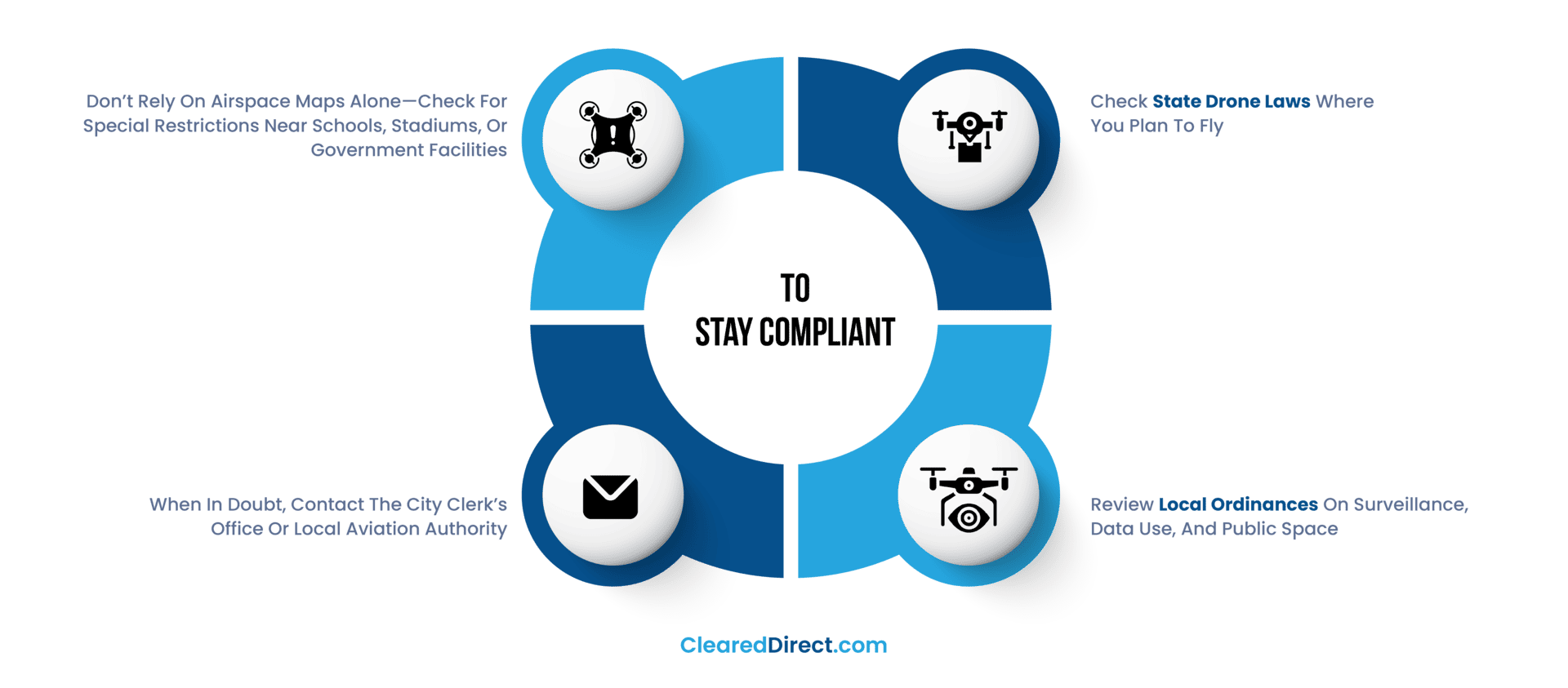
The FAA may control national airspace, but that doesn’t give you free rein at ground level. Many states—and even some cities—have their own rules when it comes to drone compliance, especially around surveillance and privacy.
If you’re operating commercially, don’t assume FAA clearance covers everything. Here’s how some of the most restrictive states approach commercial drone laws, particularly for surveillance operations:
Texas
Texas prohibits using drones to capture images or video over private property without express permission—unless you’re in specific professions (like surveying or oil/gas inspection). This includes rooftops, backyards, or anything not visible from public airspace.
Texas Gov’t Section Code 423.003: Surveillance without consent is illegal in most private-use scenarios.
California
California protects residents’ reasonable expectation of privacy—and using a drone to capture audio, video, or data in a way that invades personal space can be considered a civil offense. Flying over someone’s backyard with a zoom lens? That could trigger a lawsuit—even if you’re FAA-compliant.
Cal. Civil Section Code 1708.8: You can be sued for invasion of privacy using a drone—even unintentionally.
Florida
Florida has some of the strictest drone surveillance laws in the country. Using drones to monitor people or private property without written consent is prohibited—even for commercial use. Surveillance footage without consent is not only illegal but inadmissible in court.
Florida Statutes Section 934.50: Capturing images of people or private land without permission is a misdemeanor.
New York
Drone laws in New York vary by city. NYC, for example, bans all drone flights unless you have approval from both the FAA and the NYPD. Surveillance drones are not permitted for general use and must go through a lengthy application process.
City Law: Unauthorized drone use can lead to fines and confiscation of equipment.
Illinois
Illinois has drone privacy laws in place that limit surveillance by government agencies—but also extends to commercial operators in some municipalities. If your drone captures identifying info on people without notice, it could violate local statutes.
Illinois Freedom from Drone Surveillance Act: Some cities extend the act to private operators.
Other Local Considerations
Even outside these states, many cities and counties impose their own rules:
- Austin, TX may restrict drones near large events or public buildings
- Los Angeles, CA requires special film permits for commercial drone shoots
- Chicago, IL mandates registration for commercial operators with the city
- Washington, D.C. is almost entirely a no-fly zone under federal and local rules
Wrapping-Up
So—it’s time to wrap up this read. We hope we’ve covered everything you were looking for when it comes to FAA rules, waivers, privacy, and what it really takes to operate a commercial surveillance drone the right way.
Commercial drone surveillance isn’t just about what your drone can see—it’s about how you operate behind the scenes. From licensing and Remote ID to waivers, privacy, and local laws, real compliance is layered. Staying sharp on every front isn’t just about avoiding fines—it’s how professionals build trust, protect their footage, and scale their work without setbacks. Whether you’re flying above rooftops or across job sites, one thing holds true: when your operation is built on knowledge and intent, you’re not just flying legally—you’re flying like a leader.
If we missed something you were hoping to find, let us know. And if you’re looking for professional drone services or support, feel free to [visit our service page]—we’re here to help you fly with confidence.
People Also Ask:
The FAA categorizes any drone activity supporting business operations—whether revenue-generating or internal (e.g., site inspections, security patrols)—as commercial. This triggers strict Part 107 rules, regardless of payment. Recreational flights follow simpler guidelines under the "Exception for Limited Recreational Operations" (49 USC 44809).
Key differences include:
- Mandatory Licensing: Commercial pilots need a Remote Pilot Certificate.
- Operational Limits: Commercial flights require airspace authorizations in controlled zones and compliance with Remote ID.
- Privacy Accountability: Commercial operators must adhere to state privacy laws (e.g., avoiding unauthorized filming in Texas/California).
You must hold an FAA Remote Pilot Certificate (Part 107 license). To qualify:
Be ≥16 years old, proficient in English, and pass a TSA background check.
Pass the Unmanned Aircraft General - Small (UAG) knowledge test, covering airspace classes, weather, and emergency procedures.
Renew certification every 24 months via free online recurrent training.
As of 2025, Remote ID is mandatory for most registered commercial drones. It broadcasts real-time flight data (drone location, serial number, and pilot coordinates) to enhance airspace safety and accountability.
Compliance Options:
- Built-in Remote ID: Use a compliant drone (e.g., DJI Matrice 300 or newer enterprise models) with integrated broadcasting capability. Ideal for operators purchasing new UAVs.
- Broadcast Module: Attach an FAA-approved module (like the Dronetag BS or Aeroscope ID) to legacy drones. Required for older surveillance drones lacking built-in Remote ID.
- FRIA (FAA-Recognized Identification Area): Fly only in designated FRIAs—but note these zones are not available for commercial operations (recreational use only).
- Penalties: Non-compliance risks fines up to $20,000 and license suspension. Commercial operators must use either built-in Remote ID or an external module.
Waivers are required for operations outside standard Part 107 rules. Common surveillance scenarios needing waivers:
- Night Operations: For security patrols after dark (requires anti-collision lights).
- Beyond Visual Line of Sight (BVLOS): Monitoring large facilities.
- Flights Over People/Vehicles: Crowded events or traffic areas 212.
- Application Process: Submit safety justifications via FAADroneZone, detailing risk mitigations (e.g., visual observers, geofencing). Approval takes ~90 days.
While the FAA regulates airspace, state/local laws govern privacy and data use:
- Texas: Bans capturing images over private property without consent (Code 423.003).
- California: Allows lawsuits for privacy invasion via drones (Civil Code 1708.8).
- Florida: Prohibits surveillance of people/private land without written permission (Statute 934.50).
Best Practices:
Avoid filming private residences/backyards, even in uncontrolled airspace.
Check municipal rules (e.g., NYC requires NYPD + FAA approval).
Anonymize footage to reduce liability.
References:
https://www.faa.gov/newsroom/what-know-about-drones
https://www.zenatech.com/guide-to-getting-your-drone-pilot-license-in-usa/ (license focused blog)
https://www.flyeye.io/top-guides-understanding-faa-drone-regulations/ (FAA drone regulations)
https://planeandpilotmag.com/practical-guide-to-drone-laws-regulations-for-remote-pilots/ (well structured blog)
https://skyviewlv.com/a-simple-guide-to-drone-rules-and-regulations-in-the-us/ (mentioning commercial drone regulations)
Tags:

Kevin Milewski
Kevin Milewski is the Chief Operating Officer at ClearedDirect, where he oversees operational strategy, technology implementation, and service delivery for aviation and commercial drone (UAV) projects. With a strong background in aviation services and facility management, Kevin focuses on improving safety, efficiency, and regulatory compliance across complex airport and industrial environments. At ClearedDirect, Kevin leads initiatives integrating drone surveillance, LiDAR imaging, and AI-driven facility inspection systems that help clients achieve higher safety and performance standards. His leadership contributes to the company’s commitment to precision, reliability, and data-driven decision-making in critical infrastructure operations. Kevin regularly contributes insights to ClearedDirect’s knowledge hub, covering UAV surveillance, aviation operations, and facility optimization topics. His work reflects practical industry experience and a dedication to advancing innovation in aviation and technology management. Connect with Kevin on LinkedIn to learn more about his work.
RECENT POSTS


Recent Comments
CATEGORIES
- Aviation Facility Management
- Commercial Cleaning
- Construction
- Digital Mapping & Analytics
- Drone & LiDAR Inspections
- Drone And LiDAR Guides
- Facility Cleaning Resources
- Facility Management Guides
- Facility Management Risk
- Facility Management Technology
- Facility Operations
- Facility Security Management
- Identifying & Eliminating Inefficiencies
- Operations Management Guides
- Process Optimization
- Security Management Guides
- Staffing Augmentation Guides
- Surveillance UAV Drone Guides
- UAV Drone Mapping
- Uncategorized
TAGS
2025 facility trends aerial surveillance aircraft cleaning airline operations airport compliance management airport operational risk management airport personnel airport terminal operations Aviation Operations Aviation Risk Management aviation security risk assessment aviation services AviationStaffing aviation staffing Commercial Cleaning Services Commercial Drone Surveillance Commercial Facility Security Drone Surveying Emergency Response Planning Facility Hygiene Compliance facility maintenance facility management Facility Risk Assessment Facility risk management facility services Green Cleaning for Facilities ground handling services integrated facility management services Operational Efficiency Strategies operations management outsource facility management outsourcing airline services outsourcing airport services passenger experience enhancement Physical Security Best Practices proactive maintenance Scaling janitorial operations seasonal peaks staff augmentation Staffing Augmentation Staffing Challenges Aviation terminal facility security TSA FAA risk mitigation uav infrastructure inspection uav lidar technology
Leave a Comment