
Call Anytime
512-508-8373- ClearedDirect > Blog > Facility Management Guides > A Facility Manager’s Guide to Scaling Healthcare Facility Operations Without Hiring Internally
Blog Details

A Facility Manager’s Guide to Scaling Healthcare Facility Operations Without Hiring Internally
Healthcare facilities are facing a new kind of challenge—one that isn’t just clinical. As patient volumes rise due to seasonal spikes, public health events, or shifting demographics, operational teams behind the scenes are expected to scale just as quickly.
But maintaining quality, safety, and compliance across cleaning, maintenance, and security functions becomes harder when internal staff are already working at capacity.
Healthcare facility management is more than keeping the lights on. It’s the coordination of essential non-clinical services-such as janitorial support, equipment maintenance, and security operations—that directly impact patient comfort, regulatory compliance, and staff productivity. When these systems break down, the quality of care suffers-even if clinical staff are doing their jobs well.
During high-volume periods, facility operations must support faster room turnovers, stricter infection control, and increased security oversight—without sacrificing standards or overloading internal teams. That’s why facility managers are looking to scalable support models that extend their capacity without adding headcount.
Why Healthcare Facility Management Matters Most During Surges
Coordinating Cleaning, Maintenance & Security as a Unified Operation
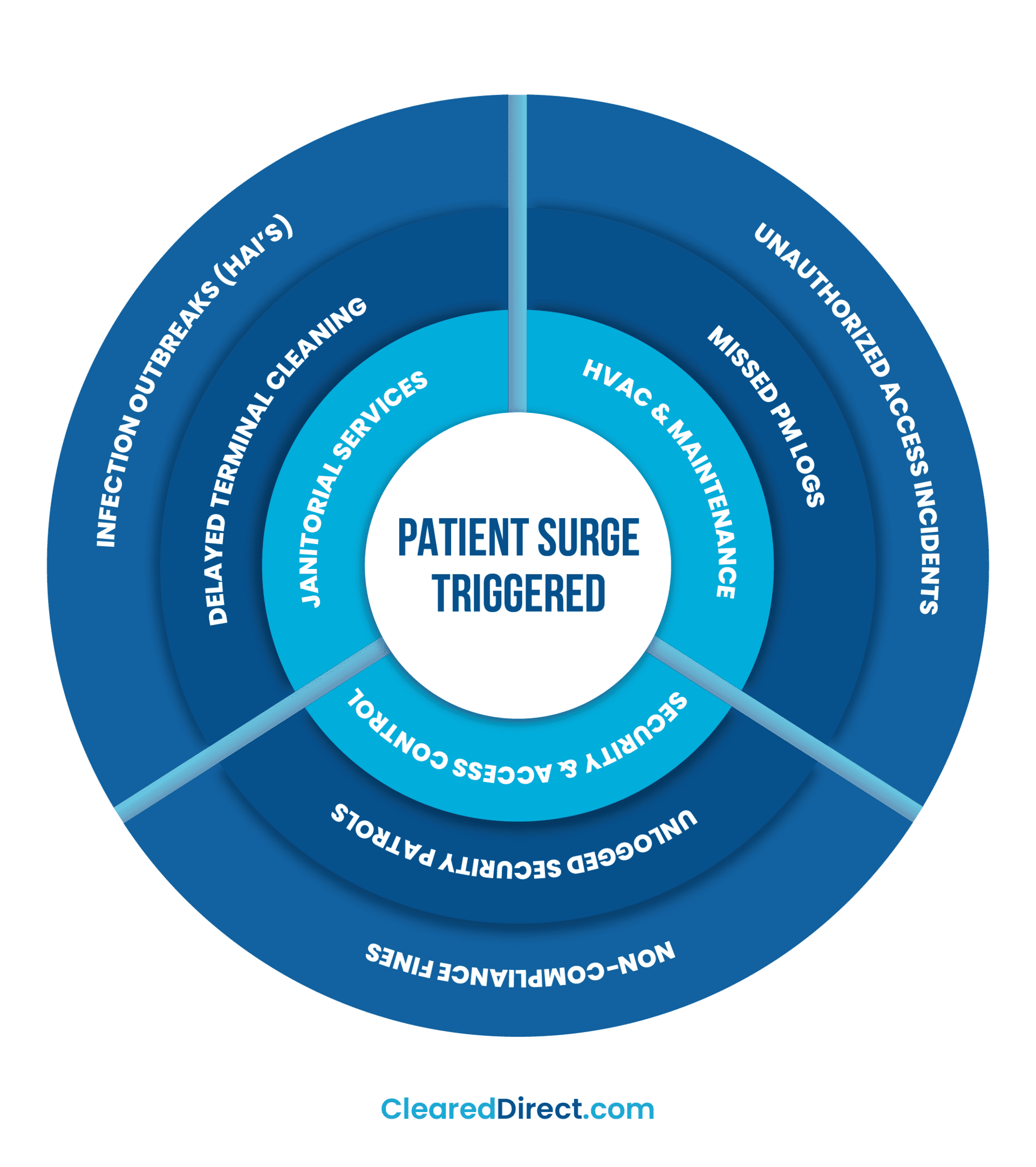
A surge in patient volume triggers a domino effect: rooms need faster cleaning, HVAC systems work harder, security monitoring must intensify. These activities fall under healthcare facility management and are key to maintaining a safe, compliant environment. Without streamlined coordination, delays in one area can disrupt the entire operation.
Infection Control Hinges on Cleaning and Maintenance
When hospitals face high occupancy, non-clinical systems like cleaning, HVAC, and security must increase output rapidly. Any lag in room turnover or sanitation isn’t just inconvenient—it’s dangerous. According to the 2023 CDC report, on any given day, 1 in 31 hospital patients has a healthcare-associated infection—an indicator that operational failures during surges directly impact patient safety.
Compliance Risk Grows When Scale Exceeds Capacity
Surges put pressure on logs, safety inspections, and patrol schedules. Gaps in HVAC checks or access control during peak periods can trigger citations from CMS or the Joint Commission. Internal teams stretched beyond their limits leave your facility vulnerable to compliance failures—even when clinical care remains untouched.
Staff Burnout Reduces Operational Quality
Overworking existing staff during a surge leads to fatigue, missed tasks, and frustration. With no additional personnel, workloads grow unsustainable. Outsourcing parts of healthcare facility management ensures operational resilience—without compromising staff morale or patient experience.
Core Facility Operations That Break Down When Volume Surges
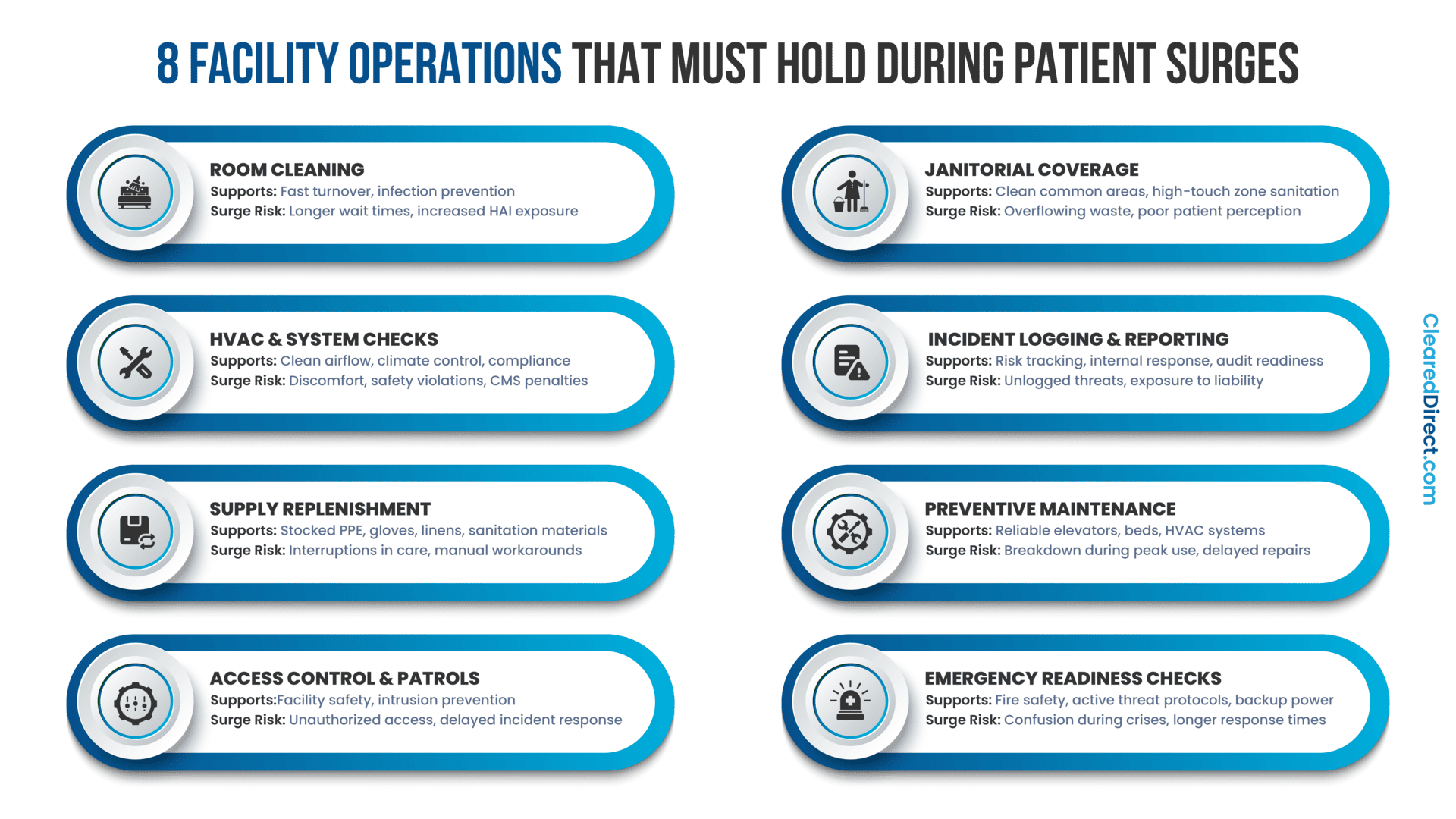
When hospitals fill up quickly, it’s not just clinical teams that feel the pressure. Behind every patient interaction is a set of operational systems cleaning, supply management, maintenance, and security-that need to function without delay. If even one of them slows down, the entire environment of care is affected.
That’s why strong, responsive healthcare facility management is critical during surge periods.
The First Thing to Slip? Room Turnover
One of the earliest signs that a facility is falling behind is a delay in cleaning discharged rooms. What seems like a small setback quickly causes a ripple. A patient waits longer in triage. A nurse juggles two beds instead of one. Families grow frustrated in the lobby. And if cleaning isn’t completed on time, the risk of infection rises. This is where consistent healthcare facility cleaning especially during peak hours—makes a measurable difference.
Where Do Things Fall Apart Behind the Scenes?
As the volume grows, the systems that usually run quietly in the background begin to lag. You’ll often see:
- Supply rooms emptying out early. PPE, sanitizers, and linens are used up faster than they can be replenished.
- Maintenance tickets going unresolved. Air systems, elevator sensors, and even basic lighting checks get deprioritized.
- High-touch areas left uncleaned. With more traffic and limited janitorial bandwidth, common spaces like restrooms and cafeterias become risk zones.
These aren’t just operational annoyances—they create real consequences for care quality and compliance.
Security Operations Start Missing the Details
During a surge, even well-staffed security teams can fall behind. And when they do, it usually shows up in the form of:
- Missed or delayed patrols—especially during staff transitions or high-traffic times
- Unreviewed access logs, which creates blind spots in who entered or exited sensitive areas
- Slower incident reporting, which affects how quickly leadership can respond to problems
These aren’t dramatic failures, but they add up. When security operation workflows can’t keep pace, the safety net becomes fragile.
How Outsourcing Strengthens Healthcare Facility Management Without Hiring Internally
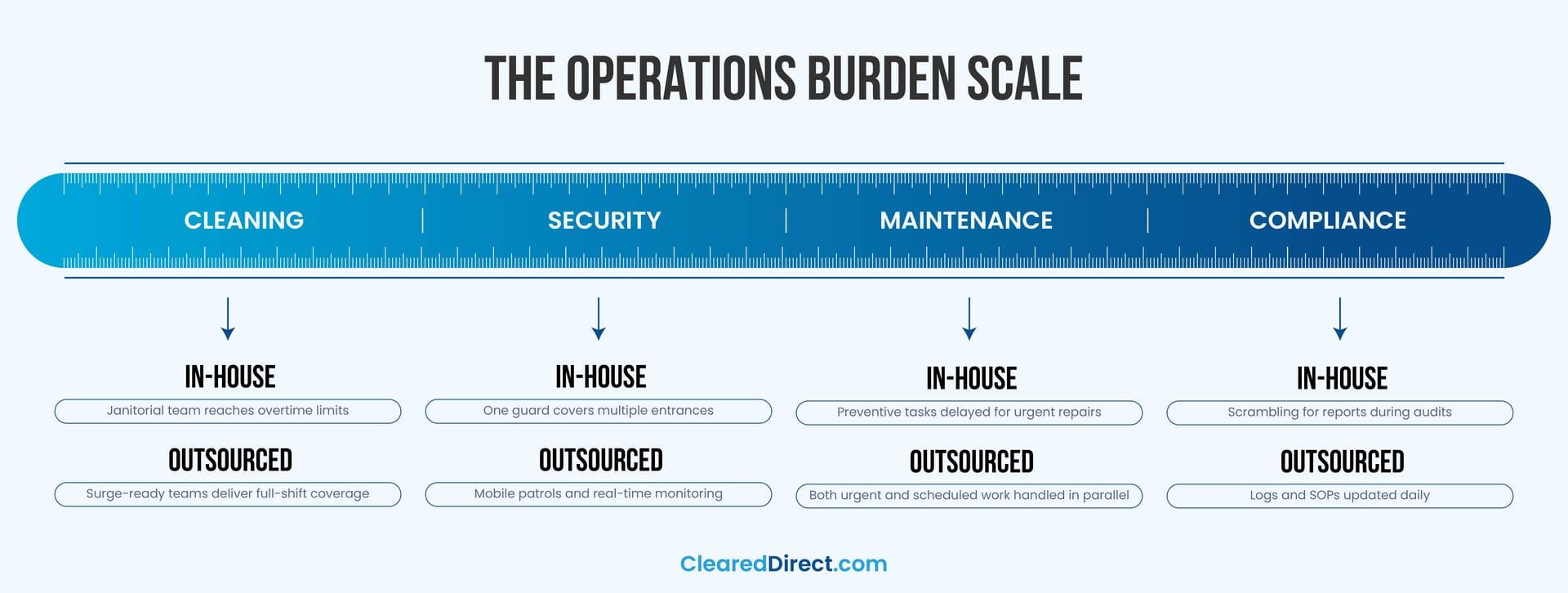
Internal hiring may feel like the default option when patient volumes spike, but it often becomes the slowest, most rigid path. Between job postings, interviews, background checks, and training, weeks can pass before a new hire becomes operational—if they show up at all. For healthcare facilities, where each delay affects patient care, outsourcing key functions offers a faster, more scalable alternative.
Outsourcing enhances healthcare facility management by introducing ready-to-deploy teams, pre-established protocols, and built-in compliance frameworks that don’t rely on internal bandwidth. Instead of burdening your clinical staff or overextending your operations team, outsourcing creates breathing room during periods of sustained pressure.
The Operational Advantages of Outsourcing
Let’s break down what outsourcing actually solves:
- No onboarding lag
Outsourced teams are trained, certified, and ready to go from day one. - Consistent SOPs across shifts
Vendors follow standardized, healthcare-grade procedures to ensure continuity. - 24/7 support without overtime
You gain after-hours, surge-period, and weekend support—without internal scheduling headaches. - Built-in compliance knowledge
Experienced partners stay updated on regulations from the CDC, OSHA, HIPAA, and other governing bodies.
This isn’t about replacing internal staff. It’s about reinforcing your operation at the exact points where internal systems often crack under volume.
For a deeper breakdown of how businesses can streamline cleaning, maintenance, and vendor oversight, explore our Business Guide read.
Cleaning Services Built Around Infection Control
With outsourced janitorial partners, healthcare facility cleaning becomes more than a daily task—it becomes a compliance strategy.
- Terminal cleans are completed using isolation-specific protocols
- Sanitation logs are maintained for audit-readiness
- Contaminated zone containment ensures safety between patient turnover
- Day porter services can be added to manage high-traffic areas during surges
The result is a visibly cleaner, consistently disinfected environment that can hold up to scrutiny from health inspectors and patients alike.
Security Operations That Don’t Miss a Beat
Outsourced technicians keep your facility operations moving—especially when small failures could escalate quickly.
- HVAC checks and adjustments protect air quality and infection control
- Emergency plumbing, electrical, or structural fixes happen without delay
- Preventive maintenance plans stay on schedule regardless of patient census
- Asset tracking and inventory management are maintained across departments
When every second counts, outsourced support keeps the facility functional, compliant, and calm.
What to Look for in a Scalable Healthcare Facility Management Partner
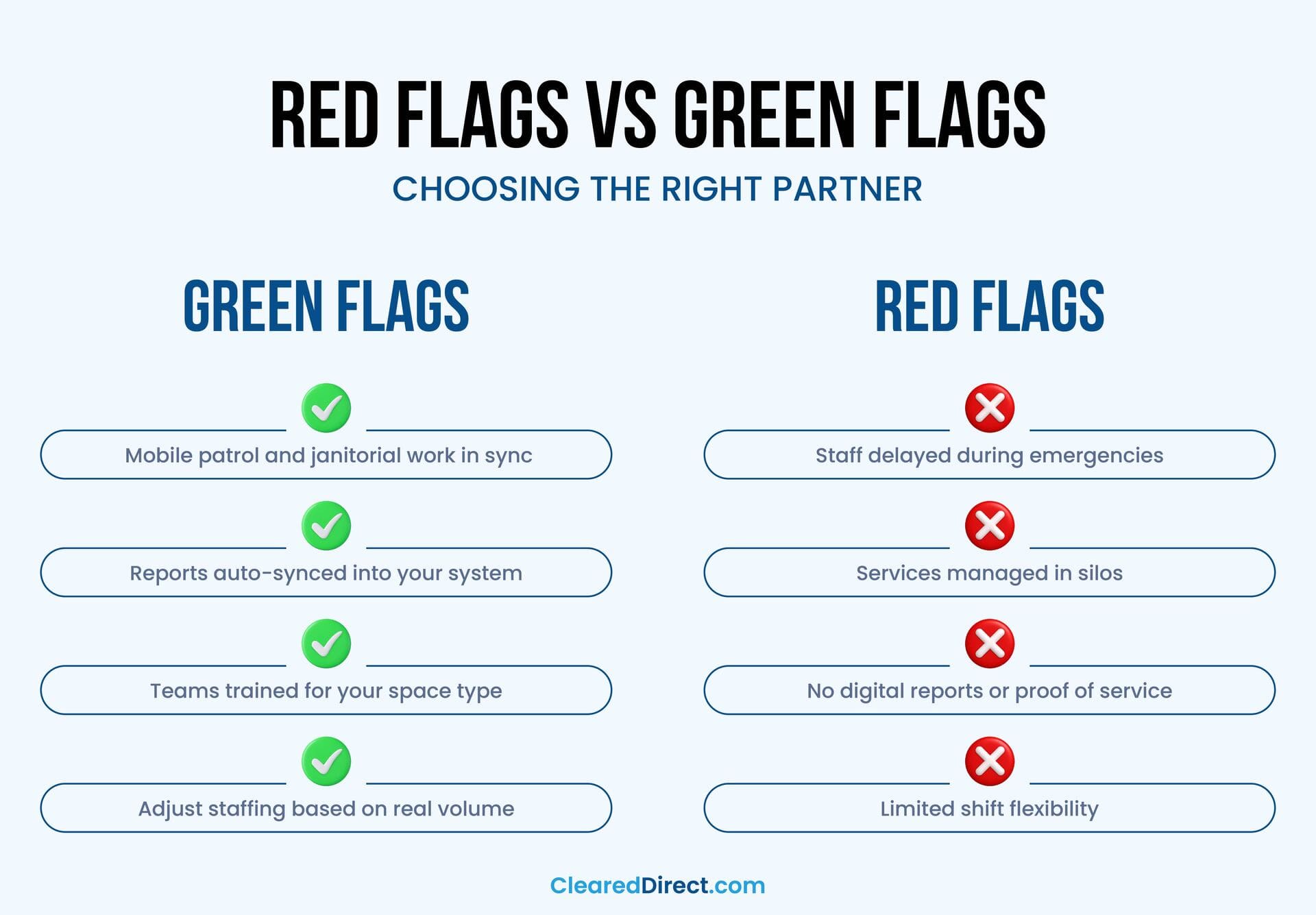
We’re answering the most important question now, when patient volume spikes, your facility systems don’t just need to work—they need to work together. A strong healthcare facility management partner ensures that cleaning, security, and maintenance stay aligned, uninterrupted, and responsive.
But not every vendor is built to scale with the needs of a care-driven environment.
Here’s what truly makes a partner scalable—especially for hospitals, clinics, and medical centers under operational pressure:
Deep Understanding of Healthcare Environments
Hospitals and clinics are not like office buildings. Patient areas require higher attention to sanitization. Staff entrances, service corridors, and visitor access points need heightened monitoring as discussed earlier. And environmental systems have zero tolerance for downtime.
Choose a partner that already understands:
- Healthcare cleaning standards
- Response expectations in patient-adjacent spaces
- The impact of service speed on patient flow and safety
You shouldn’t have to train your vendor on the stakes of your environment.
Unified Services That Reduce Bottlenecks
A common mistake? Managing different vendors for healthcare facility cleaning, facility operations, and security operations. When volume surges, those silos break.
Scalable vendors offer integrated delivery models, including:
- Daily cleaning, terminal room turnover, and waste removal
- Badge-based access control and live guard patrol
- HVAC, electrical, plumbing, and infrastructure support
This ensures faster coordination, fewer gaps, and less pressure on your internal teams.
Service Benchmarks You Can Track
Scalability is only real if you can measure it.
Strong vendors give you:
- Clear SLAs for response time, shift coverage, and task frequency
- Access to digital dashboards or reporting tools
- Flexibility to adjust coverage based on your census or occupancy levels
If a vendor cannot show how well they’re performing, they’re asking you to assume it.
Local Response Matters—Especially for Security Operation
Outsourcing only works when the support is close by. If your facility is located in Austin or similar high-volume markets, your security operation partner needs to be staffed locally, trained for your environment, and ready to deploy—not stuck in transit or coordination delays.
Ask how many on-ground team members are based in your area—and how quickly they can act when something goes wrong.
Seamless Connection to Your Existing Systems
If your team is stuck emailing updates or manually relaying issues, the vendor is not truly scalable.
Modern partners connect directly into:
- Facility ticketing systems
- Digital shift logs
- Task routing tools and maintenance trackers
You save time, avoid miscommunication, and keep a live record of everything done—without extra admin work.
Final Thoughts
When high patient volume collides with limited internal bandwidth, the consequences ripple across every corner of your facility. Delayed room turnover, stretched patrol teams, and missed maintenance windows can all disrupt care quality and increase regulatory exposure. But the solution doesn’t have to be a hiring wave.
Modern healthcare facility management is about agility—not just staffing.
By outsourcing core support functions, facilities can maintain high standards without growing payroll.
Partnering with a team that already understands healthcare-specific regulations and urgency allows you to stay compliant, responsive, and patient-ready—even during peak conditions.
Here’s what smart outsourcing can deliver:
- 24/7 healthcare facility cleaning with terminal disinfection, sanitation tracking, and surge coverage
- Trained security operation personnel who patrol, log activity, and monitor visitor access in real-time
- On-call facility operations technicians who respond to HVAC, plumbing, or electrical issues before they escalate
- Audit-aligned workflows that help safeguard against compliance violations
ClearedDirect delivers all of this—and does so as an extension of your team. From janitorial support to mobile patrols to behind-the-scenes technical coverage, we help you keep care environments clean, secure, and fully operational.
You don’t have to compromise between speed and quality. You just need the right partner.
References:
https://www.accruent.com/resources/blog-posts/what-healthcare-facilities-management-hfm
https://servicechannel.com/blog/what-to-know-about-healthcare-facility-management/
https://proptechos.com/operational-efficiency/healthcare-facilities-management/
Tags:

Kevin Milewski
Kevin Milewski is the Chief Operating Officer at ClearedDirect, where he oversees operational strategy, technology implementation, and service delivery for aviation and commercial drone (UAV) projects. With a strong background in aviation services and facility management, Kevin focuses on improving safety, efficiency, and regulatory compliance across complex airport and industrial environments. At ClearedDirect, Kevin leads initiatives integrating drone surveillance, LiDAR imaging, and AI-driven facility inspection systems that help clients achieve higher safety and performance standards. His leadership contributes to the company’s commitment to precision, reliability, and data-driven decision-making in critical infrastructure operations. Kevin regularly contributes insights to ClearedDirect’s knowledge hub, covering UAV surveillance, aviation operations, and facility optimization topics. His work reflects practical industry experience and a dedication to advancing innovation in aviation and technology management. Connect with Kevin on LinkedIn to learn more about his work.
RECENT POSTS


Recent Comments
CATEGORIES
- Aviation Facility Management
- Commercial Cleaning
- Construction
- Digital Mapping & Analytics
- Drone & LiDAR Inspections
- Drone And LiDAR Guides
- Facility Cleaning Resources
- Facility Management Guides
- Facility Management Risk
- Facility Management Technology
- Facility Operations
- Facility Security Management
- Identifying & Eliminating Inefficiencies
- Operations Management Guides
- Process Optimization
- Security Management Guides
- Staffing Augmentation Guides
- Surveillance UAV Drone Guides
- UAV Drone Mapping
- Uncategorized
TAGS
2025 facility trends aerial surveillance aircraft cleaning airline operations airport compliance management airport operational risk management airport personnel airport terminal operations Aviation Operations Aviation Risk Management aviation security risk assessment aviation services AviationStaffing aviation staffing Commercial Cleaning Services Commercial Drone Surveillance Commercial Facility Security Drone Surveying Emergency Response Planning Facility Hygiene Compliance facility maintenance facility management Facility Risk Assessment Facility risk management facility services Green Cleaning for Facilities ground handling services integrated facility management services Operational Efficiency Strategies operations management outsource facility management outsourcing airline services outsourcing airport services passenger experience enhancement Physical Security Best Practices proactive maintenance Scaling janitorial operations seasonal peaks staff augmentation Staffing Augmentation Staffing Challenges Aviation terminal facility security TSA FAA risk mitigation uav infrastructure inspection uav lidar technology
Leave a Comment