
Call Anytime
512-508-8373- ClearedDirect > Blog > Staffing Augmentation Guides > Security Staff Augmentation: When to Scale vs. Hire In-House for Commercial Facility Safety
Blog Details

Security Staff Augmentation: When to Scale vs. Hire In-House for Commercial Facility Safety
Managing a large facility often raises a critical question: is your security staff model truly built for the challenges you face?
Many leaders in commercial facility security find that their teams handle the routine well, but things become less certain when demand spikes or unexpected audits arrive.
With that said, the decision often comes down to whether to keep security services entirely in-house or to bring in support through augmentation. Both have their place, but the impact on cost, compliance, and risk can be very different.
This guide walks through the exact strengths and limits of each model, showing when augmentation becomes the smarter option. By the end, you will have a clear view of how to align your staffing choices with long-term commercial facility security goals.
Why Physical Security Is Essential in Facility Management
Let’s start with a number, around 40% of business leaders in the U.S. reported an uptick in physical security incidents last year, pushing them to reevaluate their commercial facility security measures.
Which obviously tells the threat isn’t theoretical, it’s real, and growing with each passing year.
Every facility, whether it is an airport terminal, a corporate campus, or a commercial property, carries risks that cannot be managed by cameras or access badges alone. Facility security management today involves layers of protection that account for people, infrastructure, and regulatory demands.
A weak system leaves gaps that can translate into costly downtime, liability claims, or compliance failures.
A well-built security management facility integrates prevention, monitoring, and response into everyday operations. That means ensuring entrances and perimeters are staffed properly, inspection routines are documented, and incident protocols are clear and practiced. When these processes are part of daily routines, security shifts from being reactive to becoming an operational backbone that keeps everything else running smoothly.
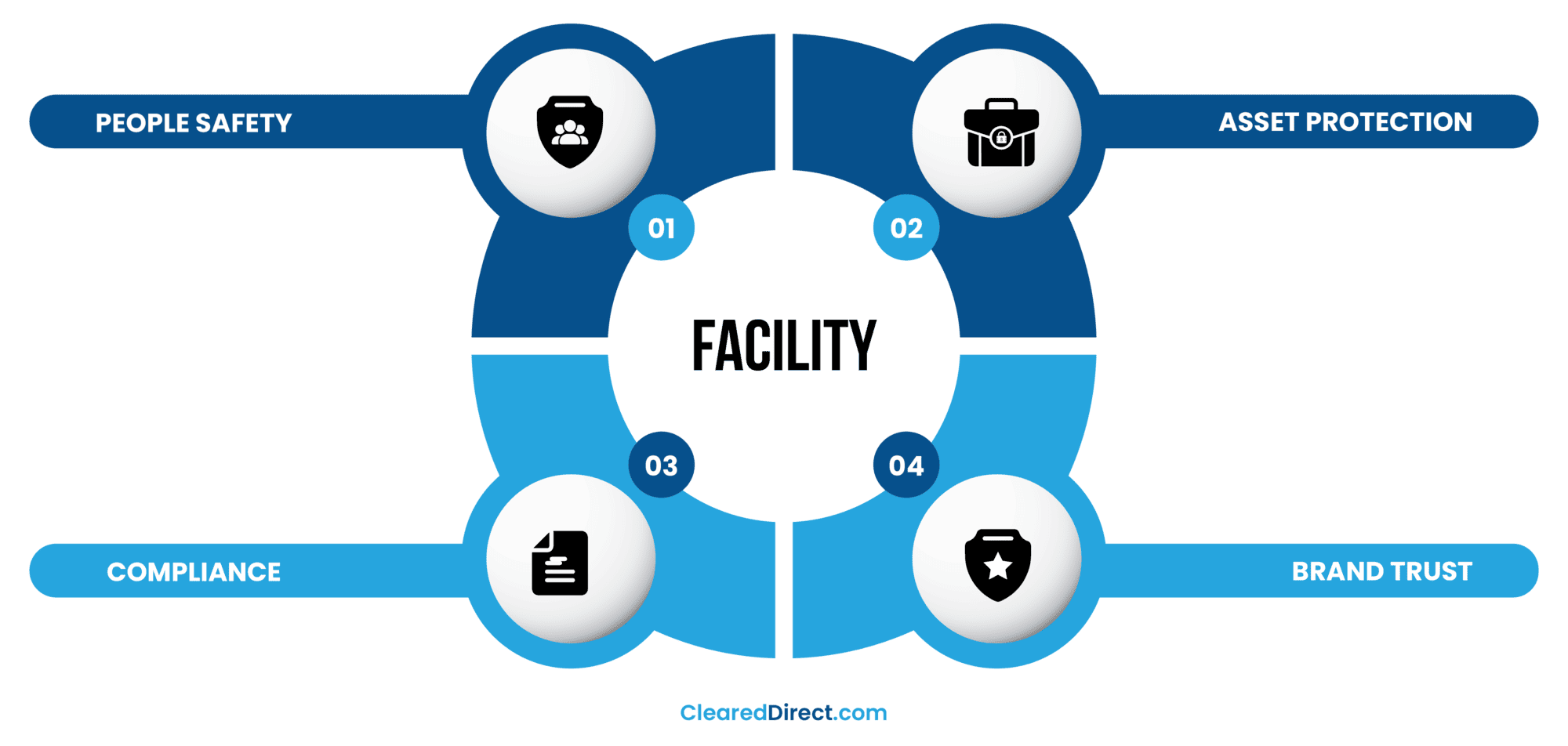
There is also a reputational side. Stakeholders notice when commercial management security is well-executed. Safe environments encourage tenants to renew leases, reassure employees who work late hours, and give customers confidence in the facility’s professionalism.
The Limitations of In-House Security Staff
Speaking of the small & mid-size businesses, managing security internally feels more like a natural choice.
The reason is simple: teams know the site, understand its routines, and give management direct oversight. While this seems efficient at first, the cracks begin to show as the operation scales or the demands on the team grow. The most common pain points are related to cost, scalability, and compliance.
The Hidden Cost of Control
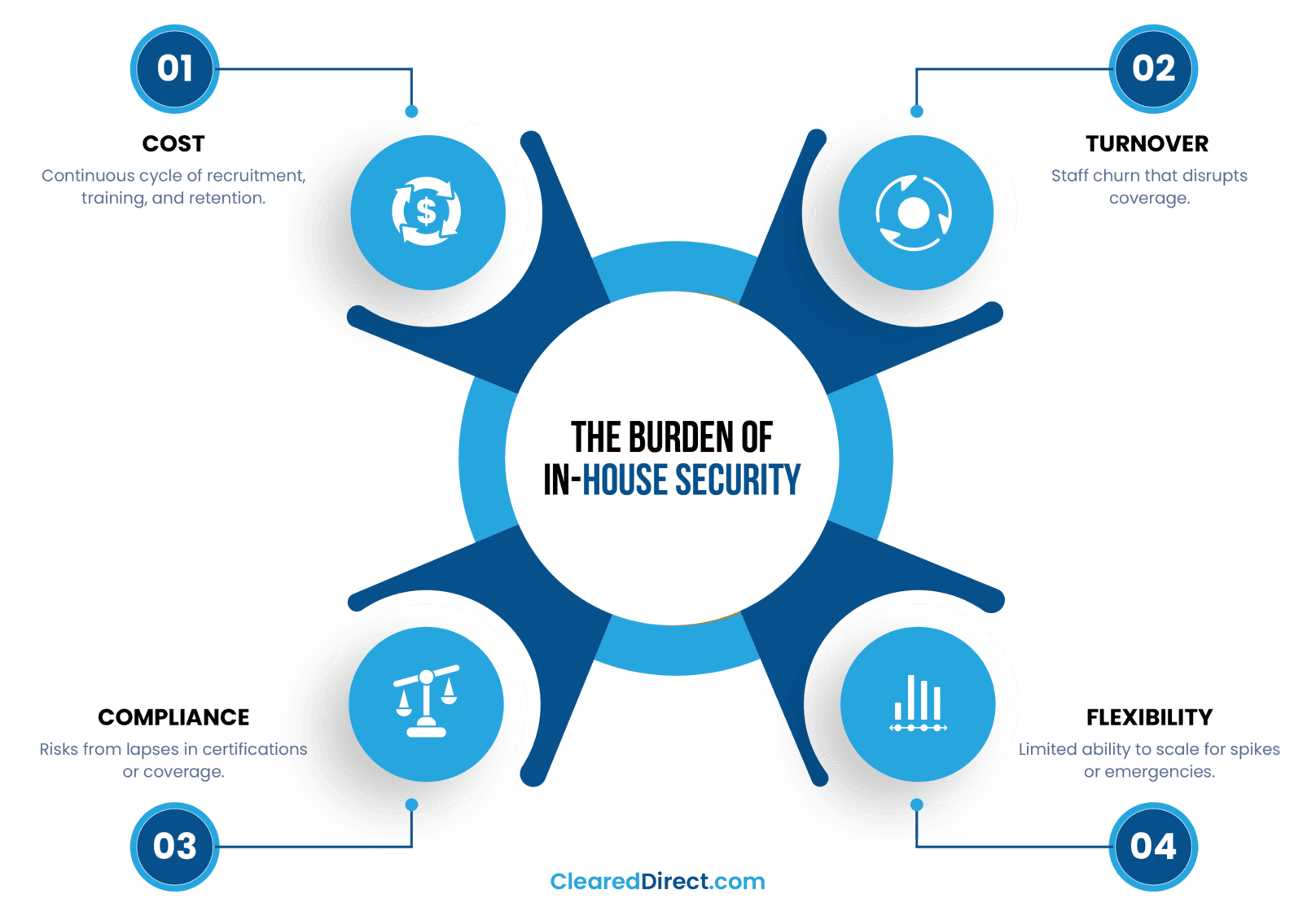
Maintaining an in-house model of security staff may look straightforward, but the reality is far more demanding. The expenses extend well beyond salaries:
- Recruitment and onboarding – Every new hire requires background checks, vetting, and orientation.
- Training and certification – Ongoing costs for safety drills, compliance programs, and re-certification.
- Benefits and retention packages – Healthcare, overtime, and bonuses quickly increase overhead.
- Turnover costs – Each resignation restarts the cycle, forcing managers to spend again on recruitment and training.
Even with these investments, coverage is never guaranteed. Absences from illness, vacations, or expired certifications create gaps in facility security management that weaken protection. When audits or inspections happen, these lapses can result in fines or reputational damage, adding to the true cost of control.
The Scalability and Complexity Gap
Beyond costs, scalability is where in-house teams often fall short.
A permanent workforce has fixed capacity, which makes commercial management security fragile during peak demand. Seasonal surges, high-traffic events, or unexpected crises cannot be handled by simply stretching the same people across more hours.
Fatigue and errors creep in, reducing effectiveness at the exact time coverage should be strongest. The responsibilities themselves have also grown more complex.
Modern security management facilities are expected to manage layered tasks: monitoring multiple entry points, coordinating evacuation protocols, supervising contractors, and maintaining compliance documentation. When these duties fall on a static, understaffed team, the risk of oversight increases sharply. Instead of reinforcing resilience, the in-house model can leave operations exposed during critical moments.
The Case for Security Staff Augmentation
What Staffing Augmentation Delivers
One of the biggest frustrations for facility managers is the time it takes to bring new people on board. Job postings, background checks, and training all add delays, and meanwhile the building still needs full coverage.
Augmentation solves this by giving managers access to security staffing solutions that are already in place and ready to go.
With augmentation, facilities can count on:
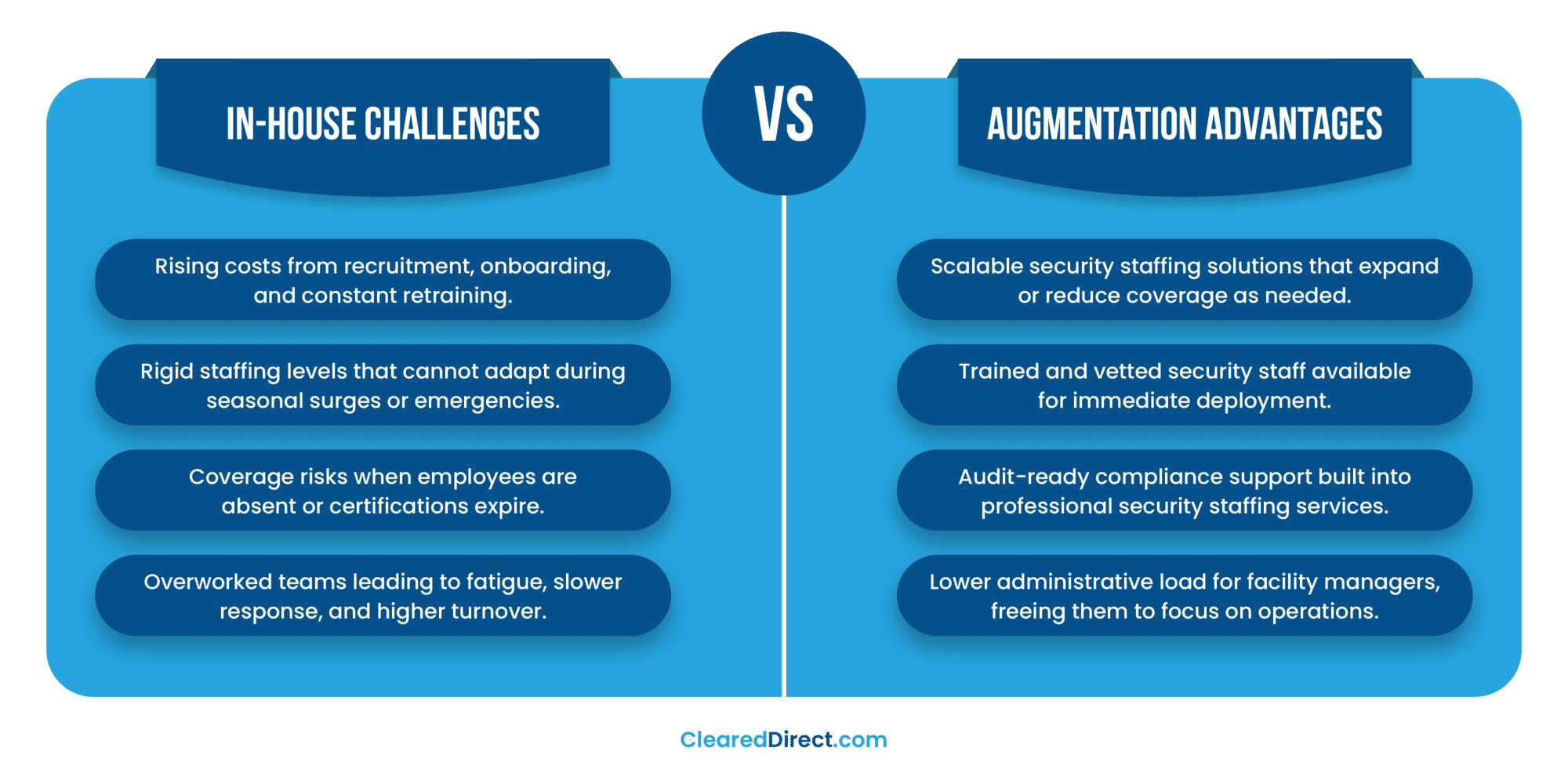
- Security staff who are trained, vetted, and prepared to step in without long lead times.
- Teams who understand compliance requirements, keeping records and procedures up to standard.
- Coverage that grows during busy seasons and scales back when things return to normal, so costs stay balanced.
- Fewer headaches around recruitment, payroll, and benefits since those are handled by the provider.
Instead of scrambling to fill shifts or worrying about certifications, managers can keep their focus on running the facility while knowing that their commercial facility security is covered.
Why It Works in Practice
Flexibility matters most when pressure is high.
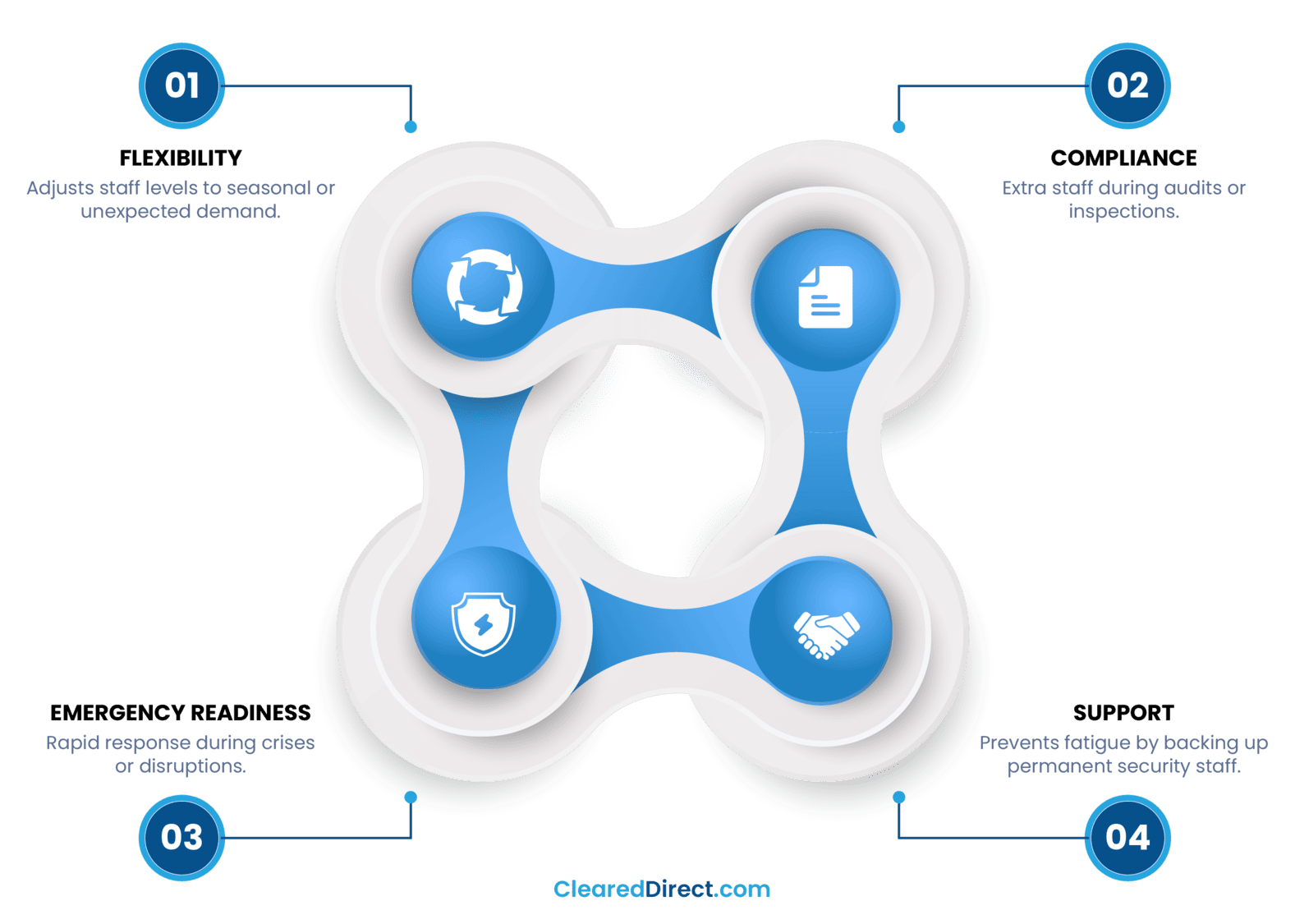
During audits, augmented teams ensure every checkpoint is staffed and every record is complete. When seasonal spikes hit, like holiday shopping in retail or summer travel in aviation, additional security staffing services can step in without overloading the permanent team. In urgent situations, such as a natural disaster or emergency response, the ability to deploy trained personnel quickly keeps operations steady.
Augmentation is not a replacement for in-house staff. It is a way to support them. Permanent teams remain the core of security, but augmentation fills the gaps that a fixed roster cannot always handle.
By blending the two models, facilities can maintain everyday stability and still be prepared for peaks or disruptions. For industries with heavier demands, such as aviation, staffing augmentation shows how flexible support can be integrated seamlessly into complex environments.
When to Choose Staffing Augmentation vs. In-House
To answer this, the choice between staffing augmentation vs in-house has no one liner answer.
No single model works for every site. The decision depends on factors such as stability, compliance pressure, and the ability to adapt when demands change. Both approaches have an important place in modern facility security management, but the real key is knowing when each fits best.
When In-House Works Best
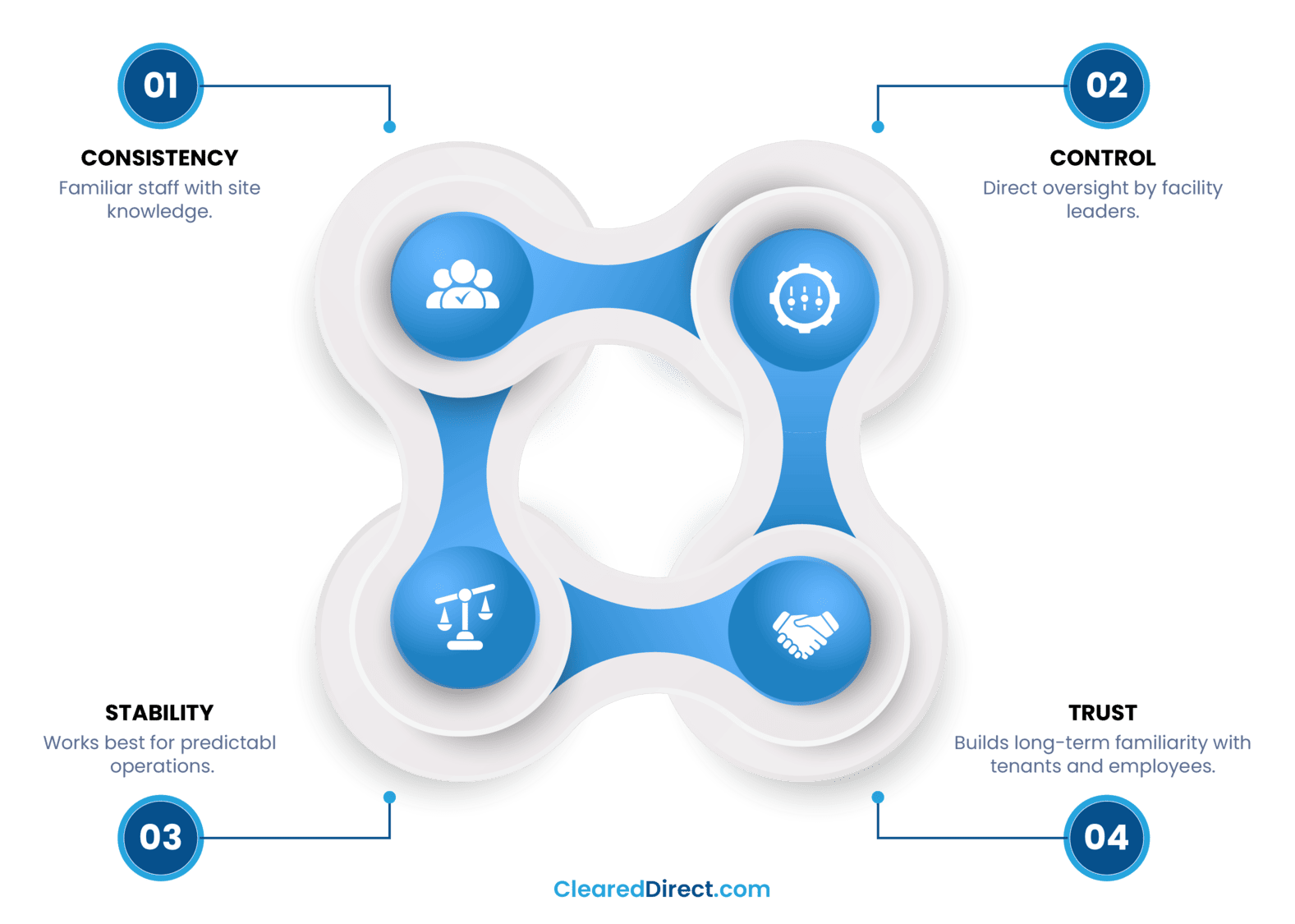
Facilities with stable operations often find value in keeping a permanent team. A core group of guards becomes familiar with routines, staff, and the layout, making day-to-day operations seamless, as we already cover in the above section.
In these cases, security management facilities benefit from consistency and a sense of accountability. Direct oversight also gives leadership greater control, which is important for offices, residential complexes, and smaller commercial spaces where activity levels rarely change.
When Augmentation Is the Smarter Choice
Facilities that face fluctuating demand, strict compliance checks, or rapid change often need more flexibility. Retail spaces during the holiday season, airports during peak travel, or hospitals preparing for inspections all benefit from scalable security staffing services.
Staffing Augmentation adds trained personnel without putting strain on permanent teams, ensuring compliance and safety without gaps. This approach also strengthens commercial management security by keeping the system resilient during times of pressure.
Finding the Balance
In reality, the strongest programs combine both. A reliable in-house team provides stability, while augmentation ensures adaptability when pressure rises. This balance turns facility security management into a proactive system rather than a reactive one, creating resilience without inflating costs.
The Business Case for Commercial Facility Security
Fixed Costs or Flexible Investment?
Let’s look at this from the business’s perspective: running an in-house program means committing to salaries, benefits, recruitment, and training year after year, right?
But what happens when demand dips? Facilities end up paying for coverage they don’t always need. Augmentation changes this by shifting costs with demand, turning security from a fixed expense into a flexible investment.
Questions worth asking:
- Are you paying for full staffing even during quiet periods?
- Do overtime costs outweigh the value of your permanent team?
- How much time is leadership spending on recruitment instead of strategy?
- Would variable costs give you more freedom to handle unexpected changes?
- If demand spiked tomorrow, could your current team scale without gaps?
By addressing these questions, you’ll gain a clearer understanding of your facility’s needs and be able to predict costs more accurately. With a strategic shift from a fixed model to a flexible staffing model, it becomes easier to maintain efficiency and long-term stability.
Reducing Risk While Improving Continuity
Security isn’t just about balancing the budget, it’s about minimizing exposure to risk. Each absence, each expired certification, and each overworked guard on overtime increases the chance of an incident.
With flexible security staffing solutions, continuity becomes predictable, even when conditions shift.
Value points to consider:
- Lower liability through access to certified security staffing services.
- Consistent performance during seasonal peaks, compliance checks, or emergencies.
- Reduced turnover stress—qualified security staff ready to step in keeps the system steady.
- Ability to reallocate leadership time away from scheduling issues and toward long-term planning.
- Stronger commercial facility security programs that adjust smoothly instead of breaking under pressure.
Beyond Costs: Building Resilient Security Management Facilities
Security decisions should never be measured on ROI alone. A strong program is also about resilience, the ability to keep people, assets, and operations safe when conditions change. Robust facility security management supports continuity during crises, while integrated commercial management security ensures compliance with standards like TSA and OSHA.
Future-ready models rely on trusted security staffing services, giving facilities the flexibility to operate under any condition. Over time, mature security management facilities reduce exposure, safeguard reputation, and create long-term stability.

Final Verdict
So we have covered enough ground to see how in-house models and staff augmentation each play a role in keeping facilities secure. With that in mind, let’s summarize the key takeaways.
In-house teams deliver stability, familiarity, and direct oversight, but they struggle with scalability, turnover, and compliance gaps. Augmentation, on the other hand, provides flexibility, pre-trained security staff, and coverage that adapts to both routine and peak conditions. Together, they form a stronger approach to commercial facility security, one that balances continuity with resilience.
This decision is not only about cost—it is about risk reduction and operational confidence. Flexible security staffing solutions ensure that managers are not left vulnerable when pressure rises, whether from seasonal demand, audits, or emergencies.
If your facility is ready to strengthen this balance, ClearedDirect can help.
Connect with ClearedDirect today to explore staffing models that reinforce your security strategy and keep your operations resilient.
References
https://www.farsight.co.uk/blog/security-strategies-and-solutions-for-facility-management
https://www.linkedin.com/pulse/enhancing-security-safety-facility-management-crucial
Tags:

Kevin Milewski
Kevin Milewski is the Chief Operating Officer at ClearedDirect, where he oversees operational strategy, technology implementation, and service delivery for aviation and commercial drone (UAV) projects. With a strong background in aviation services and facility management, Kevin focuses on improving safety, efficiency, and regulatory compliance across complex airport and industrial environments. At ClearedDirect, Kevin leads initiatives integrating drone surveillance, LiDAR imaging, and AI-driven facility inspection systems that help clients achieve higher safety and performance standards. His leadership contributes to the company’s commitment to precision, reliability, and data-driven decision-making in critical infrastructure operations. Kevin regularly contributes insights to ClearedDirect’s knowledge hub, covering UAV surveillance, aviation operations, and facility optimization topics. His work reflects practical industry experience and a dedication to advancing innovation in aviation and technology management. Connect with Kevin on LinkedIn to learn more about his work.
RECENT POSTS


Recent Comments
CATEGORIES
- Aviation Facility Management
- Commercial Cleaning
- Construction
- Digital Mapping & Analytics
- Drone & LiDAR Inspections
- Drone And LiDAR Guides
- Facility Cleaning Resources
- Facility Management Guides
- Facility Management Risk
- Facility Management Technology
- Facility Operations
- Facility Security Management
- Identifying & Eliminating Inefficiencies
- Operations Management Guides
- Process Optimization
- Security Management Guides
- Staffing Augmentation Guides
- Surveillance UAV Drone Guides
- UAV Drone Mapping
- Uncategorized
TAGS
2025 facility trends aerial surveillance aircraft cleaning airline operations airport compliance management airport operational risk management airport personnel airport terminal operations Aviation Operations Aviation Risk Management aviation security risk assessment aviation services AviationStaffing aviation staffing Commercial Cleaning Services Commercial Drone Surveillance Commercial Facility Security Drone Surveying Emergency Response Planning Facility Hygiene Compliance facility maintenance facility management Facility Risk Assessment Facility risk management facility services Green Cleaning for Facilities ground handling services integrated facility management services Operational Efficiency Strategies operations management outsource facility management outsourcing airline services outsourcing airport services passenger experience enhancement Physical Security Best Practices proactive maintenance Scaling janitorial operations seasonal peaks staff augmentation Staffing Augmentation Staffing Challenges Aviation terminal facility security TSA FAA risk mitigation uav infrastructure inspection uav lidar technology
Leave a Comment