
Call Anytime
512-508-8373- ClearedDirect > Blog > Facility Management Guides > Security Management Guides > Choosing the Right Security Service Provider: What to Look For
Blog Details

Choosing the Right Security Service Provider: What to Look For
You’ve already done the hard part: identifying that your facility, terminal, or operation needs dedicated security.
Now comes the decision that really matters — choosing who to trust with it.
You’re likely past the browsing phase. Now, you’re comparing — deciding which provider can actually deliver on their promises, not just say the right things in a proposal.
And if you’re in a high-traffic, high-compliance setting like an airport, commercial terminal, or transportation hub, you already know this isn’t just about “coverage.” The right partner helps keep your entire operation moving — safely, smoothly, and without disruption.
It’s not about how visible they are…..but more about how consistent they are when no one’s watching.
In this guide, we break down exactly what to look for — and what to avoid — in a security service provider. From red flags to must-have capabilities, you’ll learn how to spot whether a company is truly equipped to protect high-risk, high-movement environments especially in airports. And yes, we’ll show you where we fit into that picture — or at the very least, walk you through the right guidelines. Either way, this read is going to help you make a stronger, more confident decision.
Because when it comes to private security services, choosing well isn’t just a preference. It’s a risk management decision with real consequences.
Why Your Security Provider Decision Matters More Than Ever
When you’re responsible for securing an airport terminal, logistics facility, or transportation hub — hiring a security provider isn’t just about filling posts. But more than that….
SINCE operations are vast….
So, it’s about trusting a team to protect people, meet compliance expectations, and keep operations running smoothly, even during high-traffic or high-pressure moments.
Unfortunately, the risks are REAL — and increasing.
Did you know?
In 2024, four flight attendants, including employees of Delta Air Lines, were arrested for allegedly smuggling $8 million in drug money by exploiting the Known Crewmember (KCM) program. This program allows airline crew members expedited security screening, which was manipulated to bypass standard checks.
So when you’re evaluating private security services, what you’re really choosing is a partner in operational continuity.
The right provider understands how to protect high-risk zones, communicate with your internal teams, and meet compliance requirements without slowing down your flow. They don’t just “man a post” — they’re trained, licensed, and built for the kind of environment you operate in.
What Your Security Provider Should Be Managing
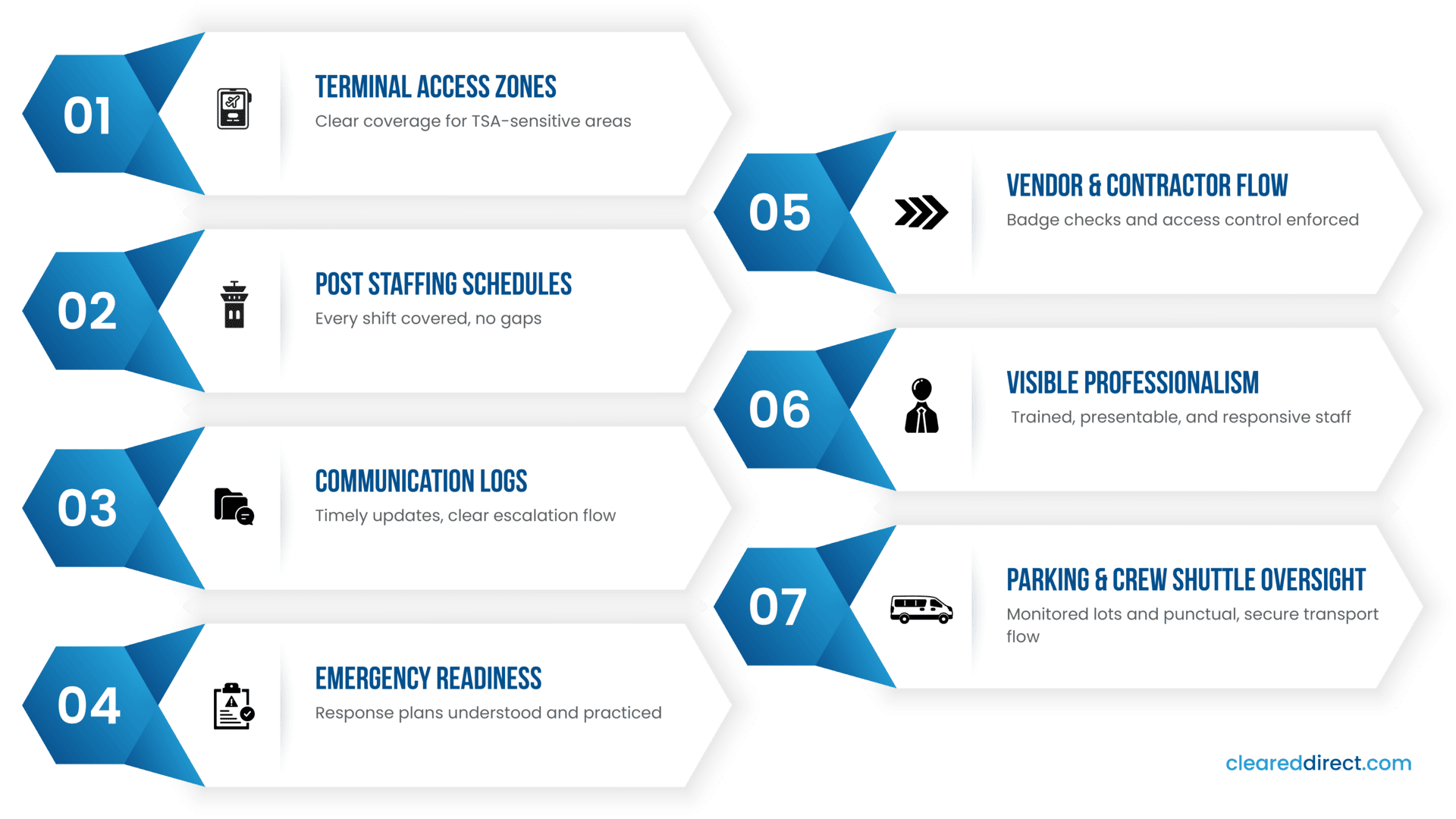
How to Know if a Security Provider Actually Fits Your Operation
You’re not choosing between “bad” and “good” providers anymore — you’re deciding between what’s sufficient, what’s exceptional, and what’s absolutely required.
The difference doesn’t always show up in the proposal. It shows up in how they think, how they plan, and how they handle the operational rhythm of your site. Especially in complex, fast-moving environments like terminals, loading zones, or mixed-use commercial spaces, that difference matters.
Here’s how to get past the marketing — and start asking questions that reveal whether a provider is truly capable of integrating with your day-to-day operations.
1. Do they understand how your facility actually works?
Any provider can say they’ve “worked in airports” or “secured transportation facilities.” But your world isn’t theoretical — it’s logistical.
Ask them:
- “How do you handle access control during peak passenger movement or shift changes?”
- “How do you manage post coverage when gates are reassigned or flights are delayed?”
- “What’s your protocol when there’s a surge in vendor foot traffic near restricted areas?”
Their answers should reference real operational scenarios, not just general policies.
A strong provider will speak in terms of movement, timing, and coordination — not just “presence” and “patrol.”
2. Do they prevent problems — or just respond to them?
A common mistake is choosing a provider based solely on their response plan. But the best teams are the ones who minimize the need for a response in the first place.
Now imagine someone audits your facility — and uncovers vulnerabilities so critical, they have the power to prevent disruptions before they ever occur.
Just Ask:
- “How do your officers monitor for behavioral indicators or escalating tension?”
- “What’s your strategy for reducing bottlenecks before they become disruptions?”
- “Can you give an example of how your team’s presence reduced incident rates over time?”
Prevention isn’t passive. It’s proactive positioning, pattern awareness, and trained attention. If the provider doesn’t talk about those things, they may only be reacting — not managing risk.
3. Will their team reinforce your internal standards — or just apply their own?
Your facility has its own expectations — on cleanliness, conduct, customer interaction, and communication flow. A good provider doesn’t replace those with their rules. They learn yours and reinforce them.
Ask:
- “How do you tailor training for our site-specific procedures and reporting expectations?”
- “How do your supervisors track whether on-site officers are meeting our SOPs?”
- “What’s your process for adjusting post orders based on our operational feedback?”
If the provider can’t speak to customization, supervision, and alignment, you’re not getting a partner — you’re getting a placeholder.
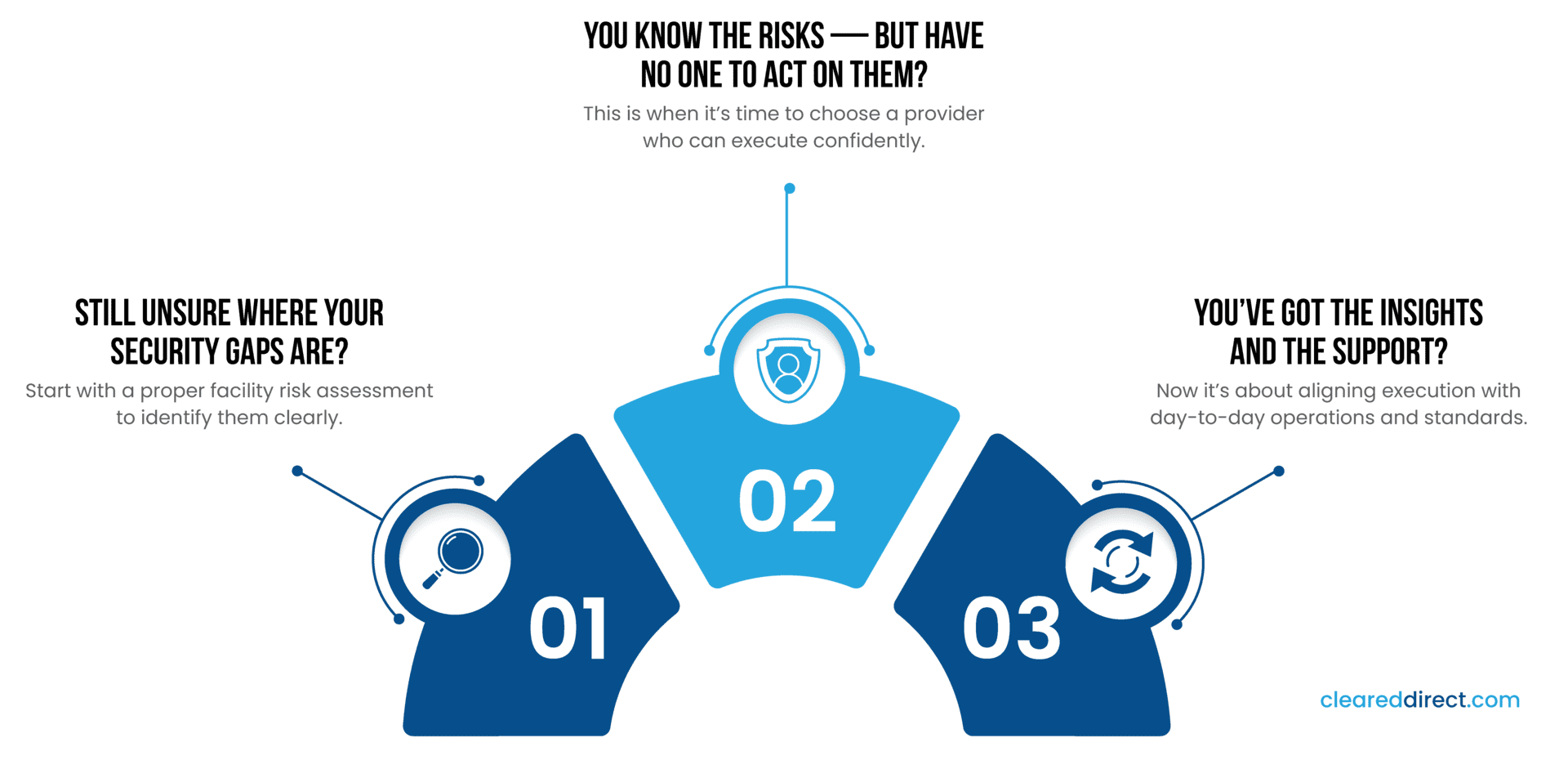
If you’ve already assessed your risks — here’s how to act on them
For many operations leaders, the first step toward better security is taking an honest look at where things currently stand — and where vulnerabilities exist.
Maybe you’ve already walked the facility and flagged areas with inconsistent guard presence. Maybe your team has noted unsecured entry points, unreliable vendor access logs, or bottlenecks around passenger flow. These types of observations are the backbone of any solid risk review — and if you’ve done that already, you’re ahead.
But recognizing those issues is just the beginning. The next challenge is deciding who’s best equipped to act on them.
At this point, the provider you bring in should already be thinking in terms of post coverage, access transitions, restricted zones, staffing flow, and liability exposure. They should be able to look at your internal findings and say, “Here’s how we can step in and close those gaps without disrupting operations.”
If you haven’t formally reviewed your facility from a risk perspective yet, that’s something worth addressing before moving forward. We recently published a full breakdown of what that process involves — including how to identify site-specific threats, evaluate critical infrastructure points, and avoid common oversights specific to airport terminals and commercial operations
Understanding the risks is what allows you to evaluate whether a provider is just offering coverage — or actually capable of improving your security posture.
Where Are You in the Decision Process?
6 Subtle Red Flags That Suggest a Security Provider Isn’t the Right Fit
By the time you’re close to making a decision, most security companies will sound the same. They’ll say the right words — licensed, reliable, experienced — and hand over polished proposals that check all the boxes.
But once the contract starts, real-world alignment is what matters. And that’s where issues can quietly surface — not through major failures, but through small gaps that grow over time.
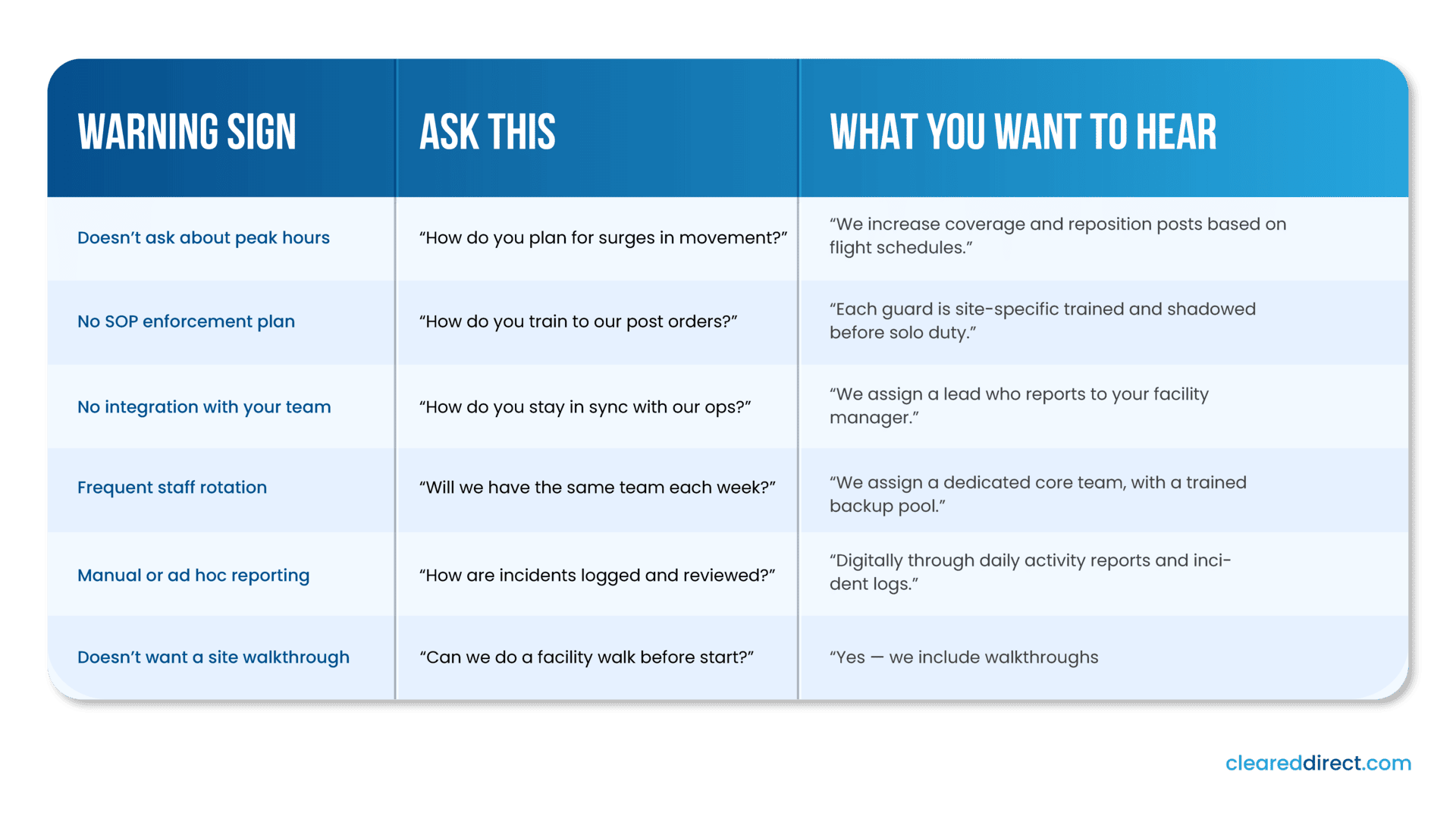
Here are six red flags that often go unnoticed until it’s too late:
They don’t ask questions about your operations
If the provider doesn’t ask about your facility’s access points, traffic flow, shift patterns, or compliance procedures, that’s a problem. Security that works is security that’s built around your environment — not a recycled playbook.
They rotate personnel frequently — without structure
Some turnover is normal. But constant rotation or last-minute subs lead to gaps in familiarity and accountability. If you’re not consistently seeing the same officers, it becomes harder to build trust or ensure training is actually site-specific.
Frequent changes can lead to confusion among staff, disrupt workflows, and reduce the effectiveness of security operations. It can also impact the quality of service, as new officers may take time to adapt to the site’s unique needs and protocols.
They focus on post coverage, not post performance
Coverage is table stakes. What matters is whether officers are actively observing, reporting, and reinforcing the right behaviors. If the provider only talks about filling posts, not what happens on them, you’re missing half the picture.
Ask:
- How are officers trained on situational awareness?
- What’s their process for identifying low-level risks before they escalate?
Reporting and supervision lack visibility
If the company can’t show you how incidents are logged, how often post audits are done, or who checks in with on-site staff, you’re relying on verbal assurance — not a verifiable process.
You should expect:
- Supervisor visits logged weekly
- Incident reports standardized
- KPI-based performance reviews quarterly (at minimum)
They rely heavily on general SOPs
Every facility is different. If you’re handed a templated “standard operating procedure” without input from your team, that’s a sign the provider isn’t building around your specific risks.
Real alignment means:
- Collaborative post order development
- Integration with your operations and emergency plans
- Flexibility based on terminal usage, passenger volume, or vendor activity
They operate in a vacuum
Good security services don’t function independently from the rest of the operation. If the provider isn’t talking about communication with facility managers, vendors, or tenant teams, they may be treating the site like a static assignment — not a living environment.
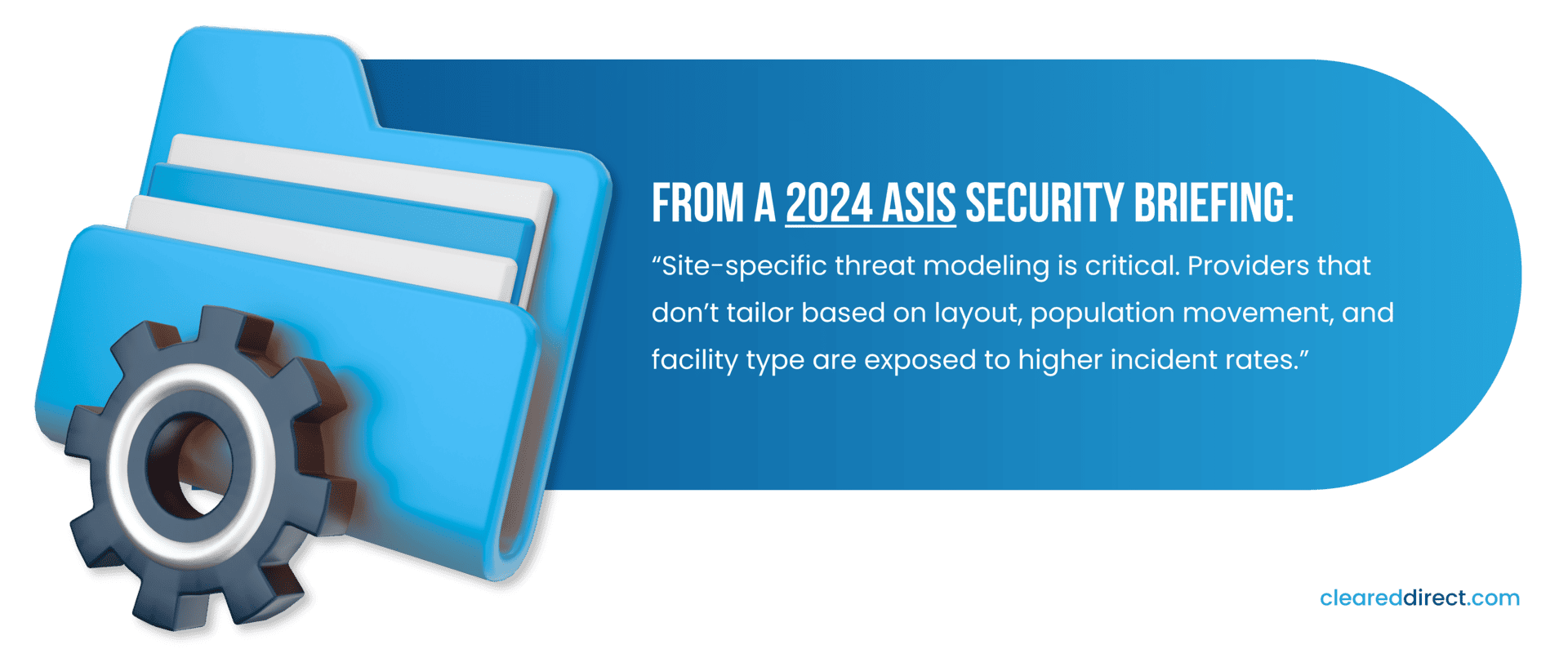
Integrated security centres can provide a coordinated, real-time response to criminal activity — enabling faster decision-making, improved situational awareness, and more effective incident containment. - IFSEC Insider
How to Vet Your Security Provider: Key Questions to Ask
Turning Evaluation into Execution: A Real-World Example
So far, we’ve explored what to look for in a security provider — especially within the context of aviation operations, where timing, access control, and compliance leave little room for error. But how does that actually play out in practice?
At Austin-Bergstrom International Airport (AUS), a major infrastructure team faced two immediate challenges: recurring theft in employee parking areas and the need to escort unbadged contractors during ongoing terminal projects. With strict timelines and heightened oversight, the solution had to be fast, flexible, and compliant with airport security protocols.
On the recommendation of AUS airport staff, the team engaged ClearedDirect. Within days, a targeted surveillance schedule was deployed to eliminate the parking lot issues, while escort operations were coordinated to keep projects moving without delay. The result wasn’t just added security — it was uninterrupted progress on a critical aviation project.
These kinds of situations highlight what matters most when choosing a provider: responsiveness, domain-specific experience, and the ability to integrate smoothly into live operations.
Because at the end of the day, aviation facilities don’t need more paperwork — they need proactive partners who can adapt to risk, close operational gaps, and keep things moving safely.
And if you’d like to learn more about how that partnership could look for your facility, ClearedDirect is just a message away.
References:
https://www.visiontron.com/strengthening-airport-security-with-effective-crowd-control-solutions/
https://www.acts-sec.com/services/airport-terminal-security-services/
https://novagems.com/best-practices-aviation-security-services-2021/?utm
Tags:

Kevin Milewski
Kevin Milewski is the Chief Operating Officer at ClearedDirect, where he oversees operational strategy, technology implementation, and service delivery for aviation and commercial drone (UAV) projects. With a strong background in aviation services and facility management, Kevin focuses on improving safety, efficiency, and regulatory compliance across complex airport and industrial environments. At ClearedDirect, Kevin leads initiatives integrating drone surveillance, LiDAR imaging, and AI-driven facility inspection systems that help clients achieve higher safety and performance standards. His leadership contributes to the company’s commitment to precision, reliability, and data-driven decision-making in critical infrastructure operations. Kevin regularly contributes insights to ClearedDirect’s knowledge hub, covering UAV surveillance, aviation operations, and facility optimization topics. His work reflects practical industry experience and a dedication to advancing innovation in aviation and technology management. Connect with Kevin on LinkedIn to learn more about his work.
RECENT POSTS


Recent Comments
CATEGORIES
- Aviation Facility Management
- Commercial Cleaning
- Construction
- Digital Mapping & Analytics
- Drone & LiDAR Inspections
- Drone And LiDAR Guides
- Facility Cleaning Resources
- Facility Management Guides
- Facility Management Risk
- Facility Management Technology
- Facility Operations
- Facility Security Management
- Identifying & Eliminating Inefficiencies
- Operations Management Guides
- Process Optimization
- Security Management Guides
- Staffing Augmentation Guides
- Surveillance UAV Drone Guides
- UAV Drone Mapping
- Uncategorized
TAGS
2025 facility trends aerial surveillance aircraft cleaning airline operations airport compliance management airport operational risk management airport personnel airport terminal operations Aviation Operations Aviation Risk Management aviation security risk assessment aviation services AviationStaffing aviation staffing Commercial Cleaning Services Commercial Drone Surveillance Commercial Facility Security Drone Surveying Emergency Response Planning Facility Hygiene Compliance facility maintenance facility management Facility Risk Assessment Facility risk management facility services Green Cleaning for Facilities ground handling services integrated facility management services Operational Efficiency Strategies operations management outsource facility management outsourcing airline services outsourcing airport services passenger experience enhancement Physical Security Best Practices proactive maintenance Scaling janitorial operations seasonal peaks staff augmentation Staffing Augmentation Staffing Challenges Aviation terminal facility security TSA FAA risk mitigation uav infrastructure inspection uav lidar technology
Leave a Comment