
Call Anytime
512-508-8373- ClearedDirect > Blog > Drone And LiDAR Guides > Surveillance UAV Drone Guides > How Drone Surveillance Enhances Safety for Commercial Facilities
Blog Details

How Drone Surveillance Enhances Safety for Commercial Facilities
Security challenges in large properties have grown more complex. Expansive footprints, multiple access points, and overlooked blind spots often leave teams struggling to maintain full visibility. Static cameras and periodic patrols aren’t always enough to prevent issues—they’re often reacting after the fact.
That’s why more organizations are turning to drone surveillance. Outsourcing this layer of protection gives sites greater control over perimeter monitoring, faster response times, and more efficient coverage without expanding internal headcount. From retail centers to aviation hubs, drones are helping property teams across the US to stay ahead of risk.
Drone surveillance improves safety for commercial facilities by delivering 360-degree visibility, reducing incident response times, and automating patrols across large or complex areas. Equipped with thermal imaging, real-time alerts, and autonomous routing, commercial security UAV drones help detect threats early, deter intrusions, and support compliance—all while lowering the operational burden on internal teams.
For facility managers and business owners, it’s a practical way to modernize security—without the complexity of building it all in-house.
Why Traditional Surveillance Falls Short
Fixed Cameras Can’t Keep Up
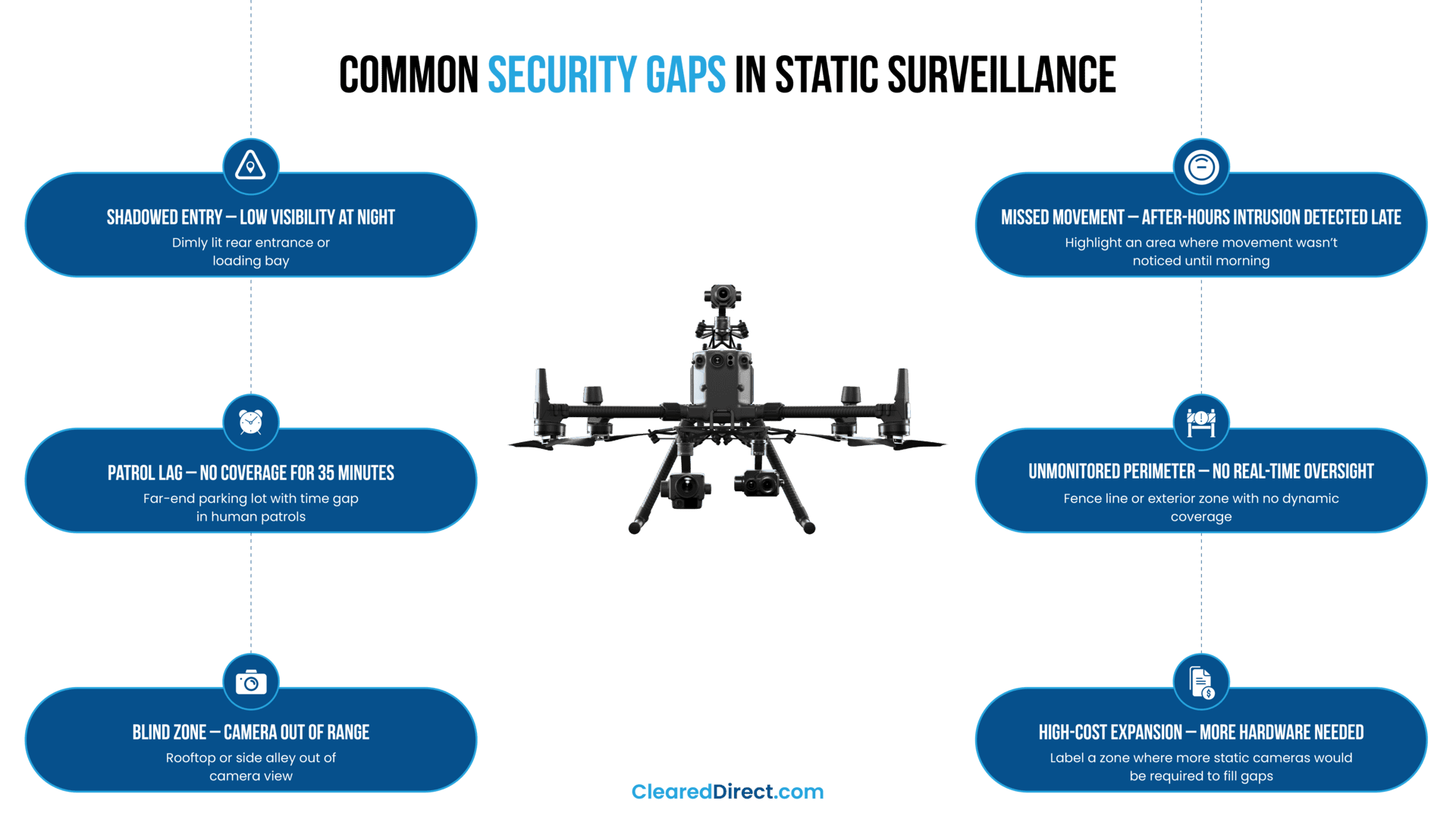
Static surveillance tools are limited by design. They don’t move, adapt, or adjust to evolving risk areas.
Many large-scale commercial facilities rely on fixed cameras, patrols, and motion lights—but these setups struggle with changing layouts, new entry points, and hidden zones. If someone moves out of view, they may never be seen again.
Patrols Leave Gaps in Coverage
Security teams on the ground are essential, but physical patrols can only be in one place at a time.
Human patrols help, but they have limits. Shift rotations, fatigue, and rigid routes mean parts of your property might only be checked sporadically—and by the time something is spotted, it could be too late.
Systems That Don’t Adapt Are a Liability
Surveillance that stays fixed while threats evolve puts your entire operation at a disadvantage.
Cameras don’t reroute themselves when a site changes. Patrols don’t automatically shift focus based on real-time risk. These tools are reactive rather than proactive, leaving opportunities for incidents to slip through unnoticed.
Real-Time Visibility Is Still a Major Gap
Without live, intelligent monitoring, most threats are only discovered after the damage is done. In the IFSEC Video Surveillance Report 2023, nearly 48% of security professionals reported installing or upgrading to edge-based, intelligent camera systems to improve real-time visibility and on-site analytics. This trend reflects how outdated systems fall short in meeting the evolving demands of commercial facility security.
How Drone Surveillance Enhances Protection for Commercial Facilities
UAV Drone-based systems are transforming how security is managed across large sites. With tools that see more, react faster, and cover ground autonomously, commercial security drones offer a level of efficiency and precision that traditional setups simply can’t match. Here’s how they elevate protection across today’s complex properties.
Aerial Perimeter Coverage in Real Time
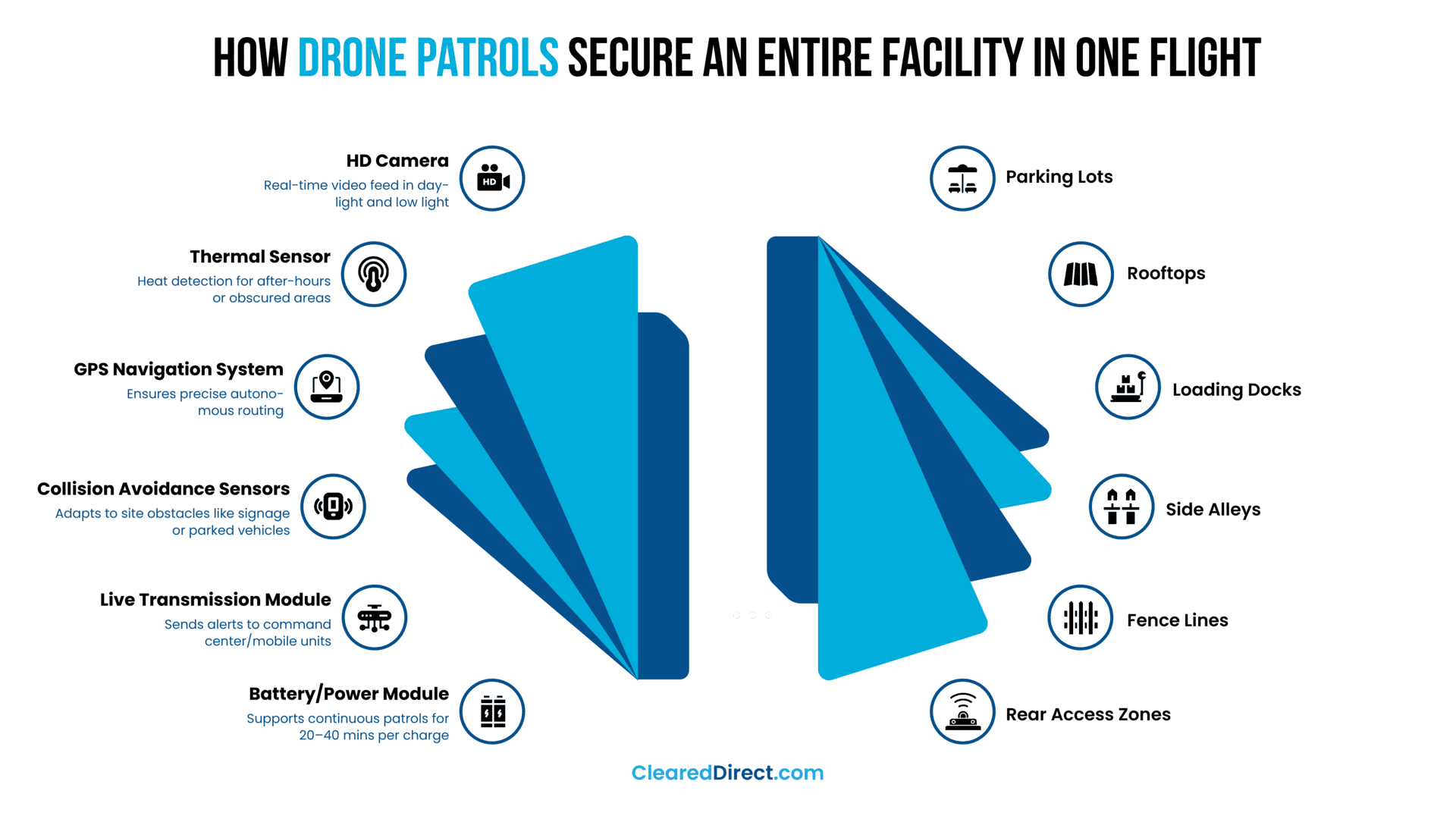
Unlike static cameras that anchor to walls or poles, drones move freely across the property, monitoring perimeters, rooftops, and less-visible zones from above. They provide 360-degree aerial oversight of the entire drone facility, whether it’s a corporate park, retail center, or industrial yard across the US.
As they fly, they detect unusual movement, fence breaches, or unauthorized access instantly—often before a threat reaches the building.
Advanced Thermal and Night Vision
Visibility shouldn’t end when daylight does. Modern commercial security drones come equipped with thermal sensors and night vision capabilities, making them especially valuable for unlit corridors, backlots, or rooftops that go unmonitored after hours.
This becomes even more critical in properties where after-dark activity increases risk or where lighting is limited by design.
Automated Patrol Scheduling
One of the most practical benefits of drone security is scheduling. UAVs can fly pre-programmed paths across commercial facilities, conducting routine sweeps without the need for manual triggers or constant oversight.
Teams can assign drones to patrol during specific shifts, respond to motion alerts, or focus on vulnerable areas based on time of day or recent incidents. This ensures no lapse in coverage, even when human resources are limited.
Instant Alert & Response Integration
UAV Drone feeds connect directly to a command center or mobile security platform. When a drone identifies movement or unauthorized access, teams receive instant notifications with live video, location markers, and heat signatures.
For facilities looking to respond in seconds rather than minutes, this kind of integration is the difference between catching an incident in progress or after it’s over.
For those managing UAV drone programs on-site or through vendors, it’s important to stay compliant with airspace regulations and equipment standards. You can explore FAA guidelines and recommended best practices, in our resource dedicated to operational drone oversight.
Where UAV Drone Surveillance Delivers the Greatest Impact
Not all commercial facilities face the same risks—or the same layout challenges. Some have expansive rooftops, others deal with constant foot traffic or strict perimeter control. What makes commercial security UAVs so effective is their adaptability across different site types without requiring separate systems or personnel for each.
The Multi-Building Challenge: Office Parks and Corporate Campuses
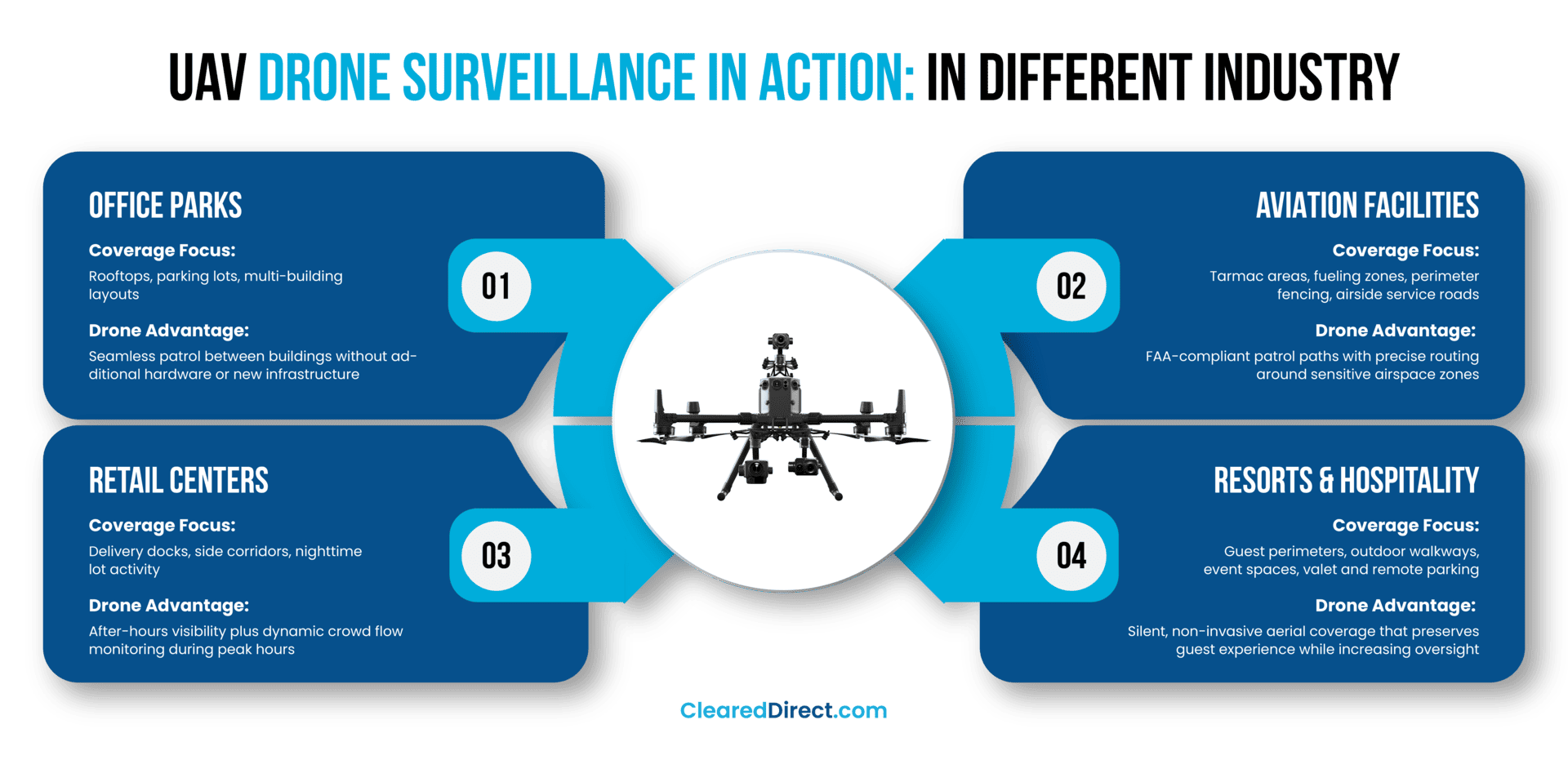
Modern office parks are sprawling, with separate buildings, massive parking areas, and unguarded rear access points. UAVs provide real-time visibility across the full campus—covering blind zones and monitoring vehicle flow without adding more guards or cameras.
They’re especially useful after hours, when lighting is limited and patrol routes are stretched thin. Drones fill in the coverage gaps between buildings and increase incident detection in otherwise hard-to-see zones.
Aviation Facilities: High Stakes, High Standards
Airports, private airfields, and aviation service properties operate in tightly regulated environments with critical zones that can’t afford visibility gaps. Drones support perimeter monitoring along runways, aircraft staging areas, fueling stations, and airside service roads—spots where fixed cameras often lack reach or flexibility.
They’re especially valuable for drone facility security teams managing compliance with FAA flight zones and safety guidelines especially in Austin. With pre-programmed flight paths, UAVs can patrol without violating restricted airspace, all while sending real-time data to command centers. That means fewer blind spots, faster incident response, and greater control over sensitive airside operations.
Retail Complexes: Active by Day, Vulnerable by Night
Commercial facilities like shopping centers and outlet malls may look secure during business hours, but after dark, parking lots, loading docks, and side corridors often go unmonitored. UAVs help bridge the gap by patrolling zones that aren’t visible to fixed cameras or easily reached by on-foot security.
During busy hours, they also provide crowd monitoring without disrupting flow—offering a helpful layer of visibility during peak traffic, sales events, or deliveries.
Hospitality Properties: Secure Without Being Seen
For resorts, hotels, and mixed-use entertainment properties, discretion matters. UAVs offer surveillance over wide areas—pools, walkways, guest parking—without being intrusive. Quiet, programmable, and aerially mobile, they help security teams respond to issues without disrupting the guest experience.
This is especially valuable for commercial facilities where aesthetics and comfort matter as much as safety.
Real ROI: Faster Detection, Lower Costs, and Better Compliance
Adopting drone security isn’t just about visibility—it delivers measurable returns for today’s commercial facilities:
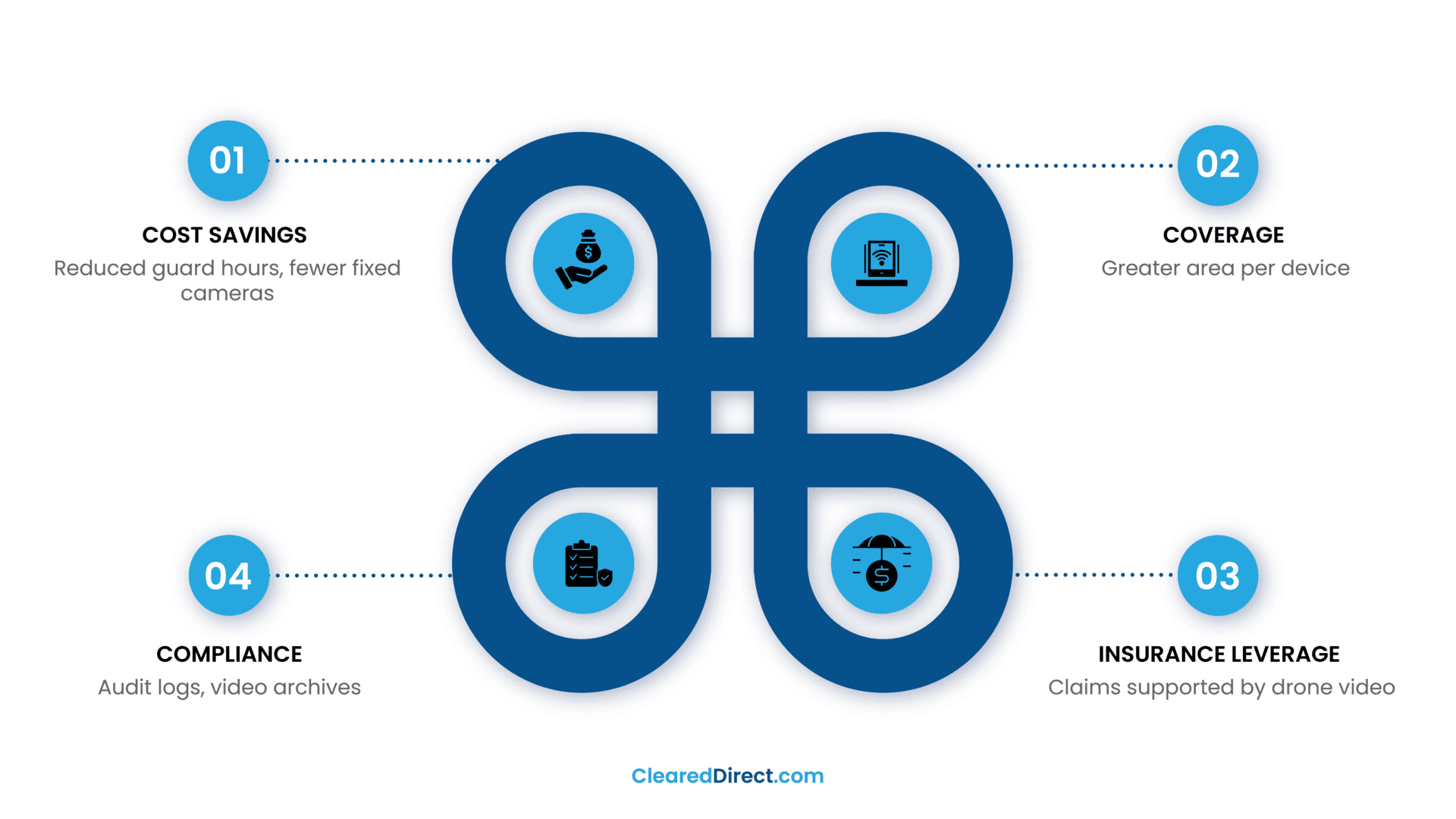
Fewer personnel, broader reach. One drone patrol can cover areas that would otherwise need multiple guards, reducing labor costs significantly.
Intrusions detected up to 5× faster. Studies show aerial systems cut down detection time by as much as fivefold compared to manual patrols, reducing losses and preventing escalation.
Compliance that pays off. According to a report from the Security Industry Association, over 60% of facilities using automated surveillance note improved audit results and smoother certification renewal thanks to clear, time-stamped logs and video documentation.
Strong insurance leverage. High-resolution footage and documented response timelines boost credibility with underwriters—leading to better premiums and faster claim processing.
Key Features to Look for in Commercial Security Drones
Not every UAV is built for real security work. When choosing a solution for a drone security facility or large-scale site, the goal isn’t flight—it’s coverage, compliance, and fast decision-making. Below are the must-have features that directly solve the operational gaps most commercial facilities face today.
Problem: Patrols Miss Critical Zones at Odd Hours
Solution: Smart Pathing and Geofencing
Allows UAV drones to fly pre-set routes across a property while avoiding no-fly zones. Ensures full perimeter coverage, even during shift changes or off-peak hours.
Problem: You Can’t Respond to What You Can’t See
Solution: Real-Time Video Streaming + Cloud Backup
Live feeds let teams act immediately—while cloud storage ensures footage is accessible for audits, claims, or investigations later.
Problem: Manual Monitoring Is Slow and Inconsistent
Solution: AI-Based Anomaly Detection
Built-in AI helps identify threats—like unusual movement or repeated presence—without relying on human operators to catch it in time. A core element of intelligent UAV drone security.
Problem: One Drone Can’t Cover Everything
Solution: Multi-Drone Coordination
Larger commercial security drone systems should support synchronized patrols. Multiple UAVs can patrol simultaneously or in sequence to prevent blind spots on expansive properties.
Problem: Non-Compliant Flights Create Legal Risk
Solution: FAA-Approved Flight Safety Systems
From automated altitude limits to return-to-base protocols, compliant drones operate safely around buildings, people, and nearby airspace—crucial for any facility using drones at scale.
Privacy, Safety & Regulatory Compliance Checklist
Before launching UAVs security, ensure your facility operation fully addresses these critical areas. Neglecting even one can result in liability, regulatory penalties, or reputational harm.
Protect Tenant, Employee & Visitor Privacy
What to do:
- Clearly define where UAV drones may record—avoid private spots.
- Implement video encryption and strict access controls.
- Establish retention and deletion policies for recorded footage.
Why it matters:
A 2024 Teledyne FLIR survey of U.S. drone professionals found that 85% identified data security and privacy as very or somewhat important when choosing a drone platform
Meet FAA Flight & Airspace Requirements
What to do:
- Limit flights to below 400 ft AGL and stay within visual line-of-sight (VLOS).
- Use geofencing tools to prevent entry into restricted airspace.
- Maintain detailed flight logs for traceability.
Why it matters:
All commercial drone ops must follow FAA Part 107, including altitude limits, night lighting rules, remote ID, and operator certification.
Ensure Secure Storage & Audit Trails
What to do:
- Use encrypted, access-controlled systems for all video files.
- Log who accessed footage, when, and for what purpose.
Why it matters:
Digital audit trails and timestamped video recordings are essential for compliance audits, insurance claims, and legal documentation—especially in multi-tenant or sensitive environments.
Install Site Signage & Publish Drone Policies
What to do:
- Post visible notifications at entry points indicating drone operation.
- Share a concise privacy notice: what data is collected, by whom, and why.
- Provide a clear contact method for questions or privacy concerns.
Why it matters:
Transparency builds trust—and many state laws require visible notice when drones are in use. Proper signage reduces complaints and demonstrates accountability.
Final Thoughts
Modern commercial facilities aren’t static—and your surveillance strategy shouldn’t be either. As risks shift, footprints expand, and operational expectations rise, relying solely on fixed cameras or rotating guards won’t hold the line. The UAV drones aren’t just a futuristic upgrade—they’re a practical, scalable layer of protection built for how facilities operate today.
With the right setup, drone security strengthens visibility, reduces blind spots, and gives your team eyes on every critical zone—without adding complexity. It’s not about replacing your current system. It’s about extending it, automating what can be automated, and freeing your team to focus where they’re most effective.
ClearedDirect works with facility managers to bring this vision to life. Whether you’re overseeing a single UAV drone facility or managing multiple commercial sites, we help design, deploy, and maintain aerial patrols that fit your footprint and compliance requirements. From FAA-aligned flight plans to thermal surveillance and secure cloud storage, every detail is handled with precision.
If it’s time to evolve your security approach without overhauling everything—ClearedDirect is ready to help.
References:
https://www.americansecurityforce.com/blog/the-benefits-of-drones-for-surveillance-and-security/
https://blog.tpcsecurity.com/drone-security-systems-perimeter/
https://www.agsprotect.com/blog/drone-security-government-facilities
Tags:

Kevin Milewski
Kevin Milewski is the Chief Operating Officer at ClearedDirect, where he oversees operational strategy, technology implementation, and service delivery for aviation and commercial drone (UAV) projects. With a strong background in aviation services and facility management, Kevin focuses on improving safety, efficiency, and regulatory compliance across complex airport and industrial environments. At ClearedDirect, Kevin leads initiatives integrating drone surveillance, LiDAR imaging, and AI-driven facility inspection systems that help clients achieve higher safety and performance standards. His leadership contributes to the company’s commitment to precision, reliability, and data-driven decision-making in critical infrastructure operations. Kevin regularly contributes insights to ClearedDirect’s knowledge hub, covering UAV surveillance, aviation operations, and facility optimization topics. His work reflects practical industry experience and a dedication to advancing innovation in aviation and technology management. Connect with Kevin on LinkedIn to learn more about his work.
RECENT POSTS


Recent Comments
CATEGORIES
- Aviation Facility Management
- Commercial Cleaning
- Construction
- Digital Mapping & Analytics
- Drone & LiDAR Inspections
- Drone And LiDAR Guides
- Facility Cleaning Resources
- Facility Management Guides
- Facility Management Risk
- Facility Management Technology
- Facility Operations
- Facility Security Management
- Identifying & Eliminating Inefficiencies
- Operations Management Guides
- Process Optimization
- Security Management Guides
- Staffing Augmentation Guides
- Surveillance UAV Drone Guides
- UAV Drone Mapping
- Uncategorized
TAGS
2025 facility trends aerial surveillance aircraft cleaning airline operations airport compliance management airport operational risk management airport personnel airport terminal operations Aviation Operations Aviation Risk Management aviation security risk assessment aviation services AviationStaffing aviation staffing Commercial Cleaning Services Commercial Drone Surveillance Commercial Facility Security Drone Surveying Emergency Response Planning Facility Hygiene Compliance facility maintenance facility management Facility Risk Assessment Facility risk management facility services Green Cleaning for Facilities ground handling services integrated facility management services Operational Efficiency Strategies operations management outsource facility management outsourcing airline services outsourcing airport services passenger experience enhancement Physical Security Best Practices proactive maintenance Scaling janitorial operations seasonal peaks staff augmentation Staffing Augmentation Staffing Challenges Aviation terminal facility security TSA FAA risk mitigation uav infrastructure inspection uav lidar technology
Leave a Comment