
Call Anytime
512-508-8373- ClearedDirect > Blog > Facility Management Guides > Security Management Guides > Outsourcing vs. In-House Security for Commercial Facilities: Pros and Cons
Blog Details

Outsourcing vs. In-House Security for Commercial Facilities: Pros and Cons
For anyone responsible for running a commercial facility, security decisions carry weight far beyond simply keeping doors locked. They influence day-to-day operations, staff confidence, tenant satisfaction, and the long-term reputation of the property.
Whether it is an office tower with high visitor traffic, a distribution center with valuable inventory, or a multi-tenant retail complex, the question is the same: should security be managed in-house or entrusted to an external provider?
The choice is not always clear. An in-house team offers familiarity and direct oversight but comes with ongoing recruitment, training, and payroll costs. An outsourcing security service can provide access to experienced personnel and modern equipment, yet requires confidence in a third party’s ability to deliver consistently.
This blog will examine the pros and cons of outsourcing compared to in-house security for a commercial facility. The goal is not to promote one approach over the other, but to help facility managers and business owners weigh factors like cost, control, scalability, and compliance — and make a decision that matches their operational needs and risk profile.
Understanding Commercial Facility Security Needs
Why Security Requirements Vary
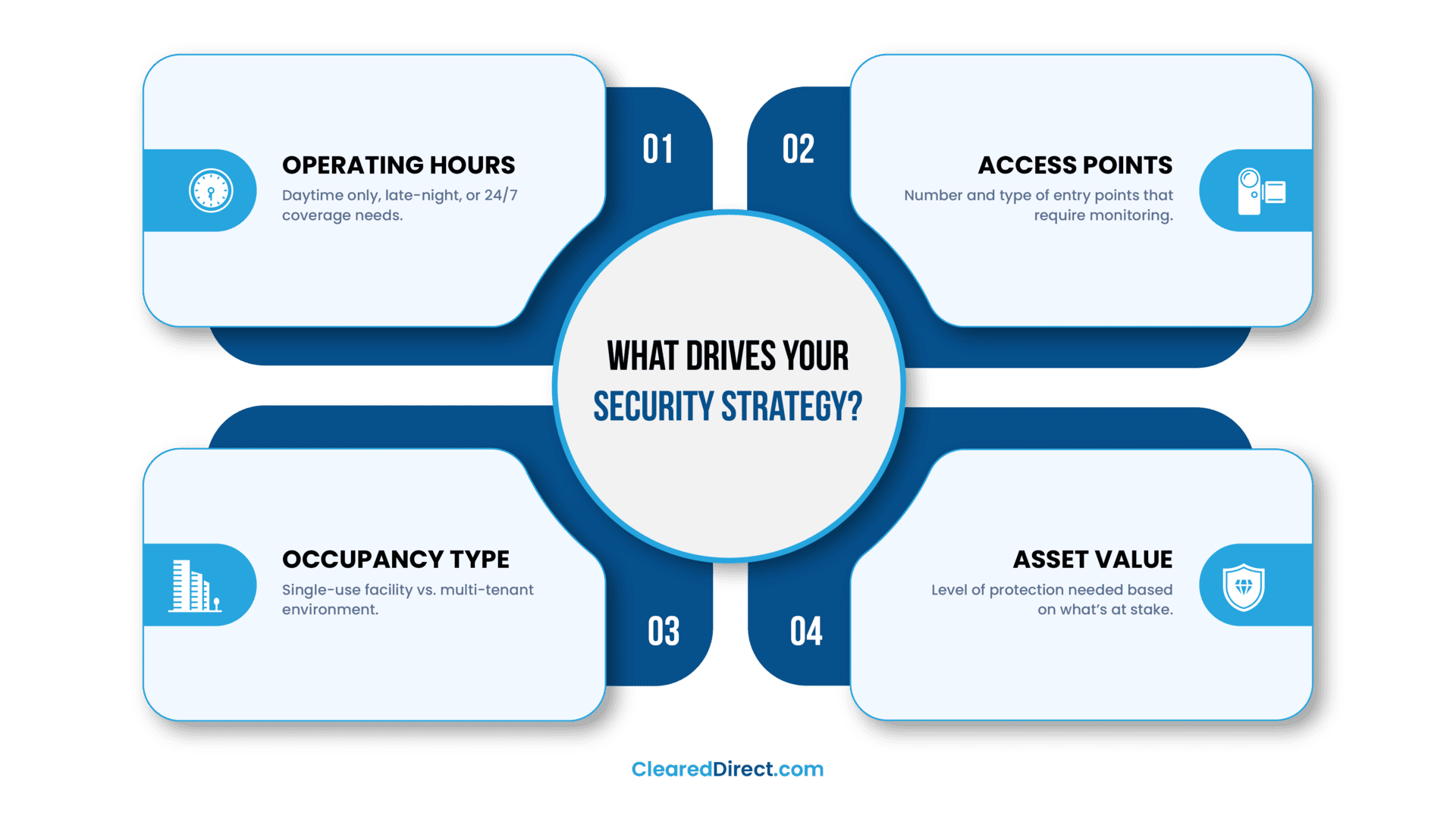
Every commercial facility operates in its own environment. A high-traffic office building faces constant visitor management challenges, while a warehouse must protect valuable goods from theft or damage. Even retail complexes, with multiple tenants and public access points, have their own security priorities.
Core Security Functions
While needs differ, most facilities rely on some combination of these functions:
- Asset Protection – Safeguarding physical goods, equipment, and intellectual property.
- Access Control – Monitoring who enters restricted areas.
- Incident Response – Reacting quickly to emergencies or disruptions.
- Surveillance – Maintaining visibility over entrances, exits, and high-risk zones.
- Crowd Management – Keeping operations smooth during busy hours or events.
Risk Profiles Are Not All the Same
Factors like operational hours, building layout, and tenant mix shape a facility’s overall risk level.
- Facilities open late or around the clock require more robust coverage.
- Multi-tenant sites may face increased security complexity due to varied access needs.
- Locations in high-crime areas may prioritize deterrence and visible presence.
When Compliance Comes Into Play
Some industries operate under strict oversight, making security a regulated necessity rather than an operational choice. In these cases, structured risk assessments help identify vulnerabilities and guide protective measures. If your industry faces similar compliance demands, our Aviation Security Risk Assessment Guide offers insights into how a methodical approach to risk evaluation can strengthen your overall security plan — even outside the aviation sector.
In-House Security: Direct Control and Cultural Alignment
Relying on your own employees for security can feel like the most hands-on way to protect a commercial facility. You decide who is hired, how they are trained, and what procedures they follow.
This level of ownership can be reassuring, especially when protecting a property that demands precision and familiarity. But while the approach offers real advantages, it also brings financial, operational, and managerial challenges that should not be overlooked.
Why In-House Security Appeals to Many Facilities
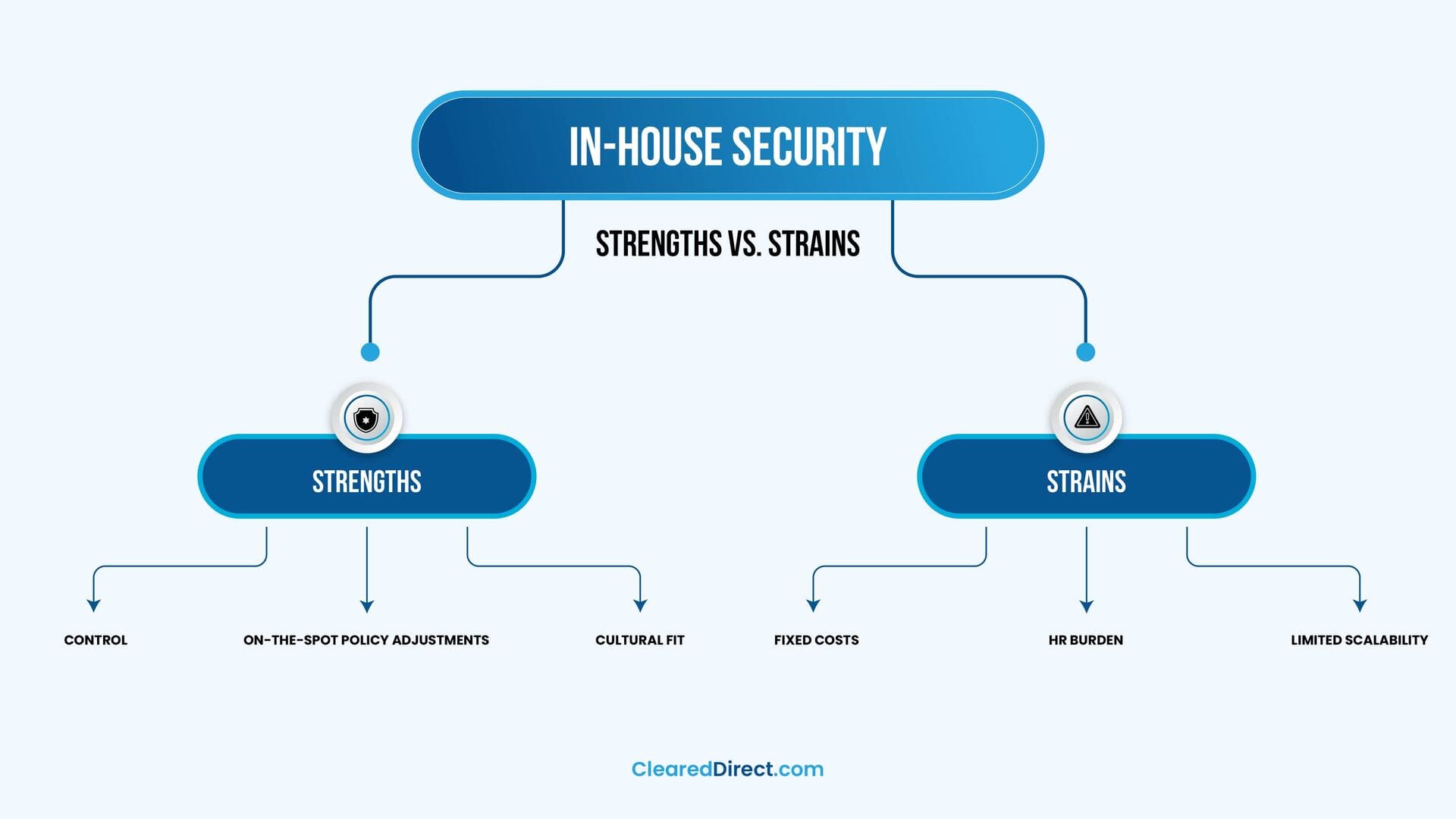
- Absolute Control
Every schedule, every protocol, and every response is set by you. There is no intermediary between the decision and the action. For many facility managers, this ability to directly manage daily operations creates confidence in the consistency of service. - Cultural Consistency
An in-house team becomes part of your workplace ecosystem. Guards learn the building’s quirks, recognize regular staff and tenants, and develop relationships that can improve communication and coordination during both routine and high-pressure situations. - Operational Flexibility
Adjusting policies or shifting responsibilities can happen immediately. Whether it is a last-minute schedule change or a new procedure, you can implement changes without waiting for vendor approval or navigating contract limitations.
The Demands and Drawbacks of In-House Security
- High Fixed Costs
Maintaining an in-house team means committing to salaries, benefits, insurance, uniforms, training, and equipment — all of which remain constant whether your security demands are high or low. Industry comparisons show that outsourcing security services can often reduce these expenses significantly, in some cases by as much as 30–40%. - Recruitment and Retention Burden
From background checks and onboarding to ongoing training and performance monitoring, staffing a security team requires significant HR resources. Turnover means repeating the process — often at a time when coverage is already running at limited capacity. - Limited Scalability
Expanding coverage for seasonal surges, events, or emergencies can be slow and costly. Overtime and temporary hires can quickly drive up budgets, and additional training time may leave you exposed during the transition period. - Liability Management
With in-house security, responsibility for compliance, licensing, and incident liability rests entirely on your organization. This requires continuous oversight to ensure all legal and procedural obligations are met.
Outsourcing Security Service — Flexibility and Specialized Expertise
For many commercial facilities, outsourcing security services offers a way to access trained professionals, updated procedures, and modern equipment without absorbing the ongoing costs of maintaining an in-house team.
Instead of managing recruitment, training, and scheduling internally, these responsibilities shift to a specialized provider whose sole focus is delivering consistent, effective protection.
This arrangement not only frees up managerial time but also allows decision-makers to redirect budgets toward other areas of facility improvement.
Advantages of Outsourced Security
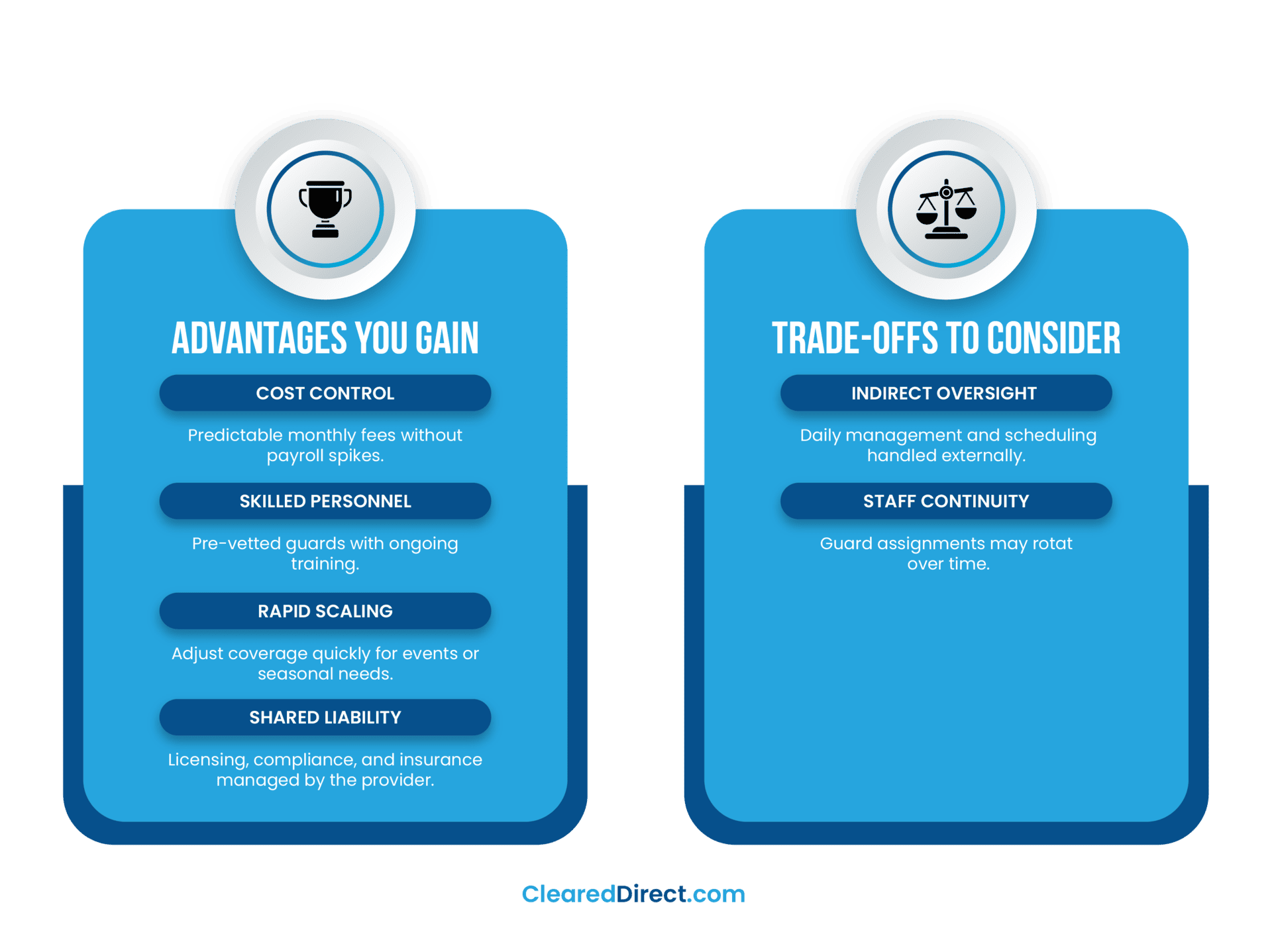
Cost Efficiency
With outsourcing, expenses like uniforms, benefits, insurance, training programs, and licensing are bundled into a single, predictable monthly fee. This eliminates the payroll fluctuations and emergency staffing costs that can occur with in-house teams. A Security Magazine report notes that outsourcing often lowers operational risk while keeping expenses stable over time — an important consideration for facilities operating on tight margins.
Access to Expertise
Providers bring in personnel who have been screened, trained, and prepared to follow industry-standard protocols. This includes incident response, emergency preparedness, and adherence to compliance requirements. For organizations operating in regulated environments, this can be a key advantage. For a deeper look at what to evaluate when selecting a vendor, see our choosing the right airport security provider guide — the same evaluation principles apply to commercial facilities.
Scalability on Demand
Whether it’s ramping up coverage during peak retail seasons, adding personnel for a special corporate event, or adjusting patrol schedules after a security incident, outsourcing allows rapid scaling without the delay of recruiting and training new hires. This adaptability means your security coverage can match real-time needs rather than fixed schedules.
Reduced Liability Burden
From licensing and certifications to insurance coverage and compliance documentation, much of the liability responsibility transfers to the provider. This not only limits direct legal exposure but also ensures that critical updates in laws and standards are handled proactively by a dedicated team.
Challenges to Keep in Mind
- Less Direct Control
Because security staff are managed by the provider, changes to individual performance, schedules, or assignments may require formal requests rather than immediate internal adjustments. - Potential Staff Rotation
Depending on staffing availability, the personnel assigned to your site may change over time. While providers aim for consistency, occasional rotation can delay the development of familiarity with your facility’s routines and culture.
Pros and Cons of Outsourcing vs. In-House Security for a Commercial Facility
When choosing between in-house and outsourced security, it helps to compare them across the areas that matter most, such as cost, control, adaptability, and expertise. Both approaches can be effective, but the differences become clear when each factor is considered side by side.
Cost
- In-House: Comes with fixed, ongoing expenses including salaries, benefits, uniforms, training, insurance, and equipment. These costs remain even when your security needs decrease.
- Outsourced: Offers predictable monthly fees that usually cover staffing, training, technology, and compliance in a single agreement. This avoids sudden payroll increases.
Control
- In-House: You have complete daily oversight of the team and can adjust schedules or procedures immediately.
- Outsourced: Oversight is managed through the provider. Changes may require a request or revision to the service agreement.
Scalability
- In-House: Increasing coverage for peak seasons or events often requires new hires or paying overtime to existing staff.
- Outsourced: Can scale up or down quickly, allowing you to match coverage to real-time needs.
Staff Familiarity
- In-House: Guards become deeply familiar with the facility, its people, and daily operations.
- Outsourced: Some rotation of personnel may occur, which can slow the process of building familiarity, although many providers try to maintain consistency.
Expertise and Training
- In-House: Training quality depends on your internal resources, which may limit access to advanced skills or updated practices.
- Outsourced: Providers bring trained and vetted staff with access to continuous development programs.
Liability
- In-House: Your organization is responsible for compliance, licensing, insurance, and any incidents that occur.
- Outsourced: Much of the compliance and licensing responsibility shifts to the provider, reducing direct exposure.
Technology and Tools
- In-House: You must budget for and manage the purchase and upkeep of security equipment and software.
- Outsourced: Many providers include access to modern technology, reporting systems, and monitoring tools within their services.
An Insight
Comparing real performance data, not just assumptions, can quickly clarify whether in-house or outsourcing delivers better value.
How to Choose the Right Security Approach for Your Facility
There are a lot of factors to consider when deciding between in-house and outsourced security service, but we’ve highlighted a few key steps that can help you make a confident and informed decision for your commercial facility.
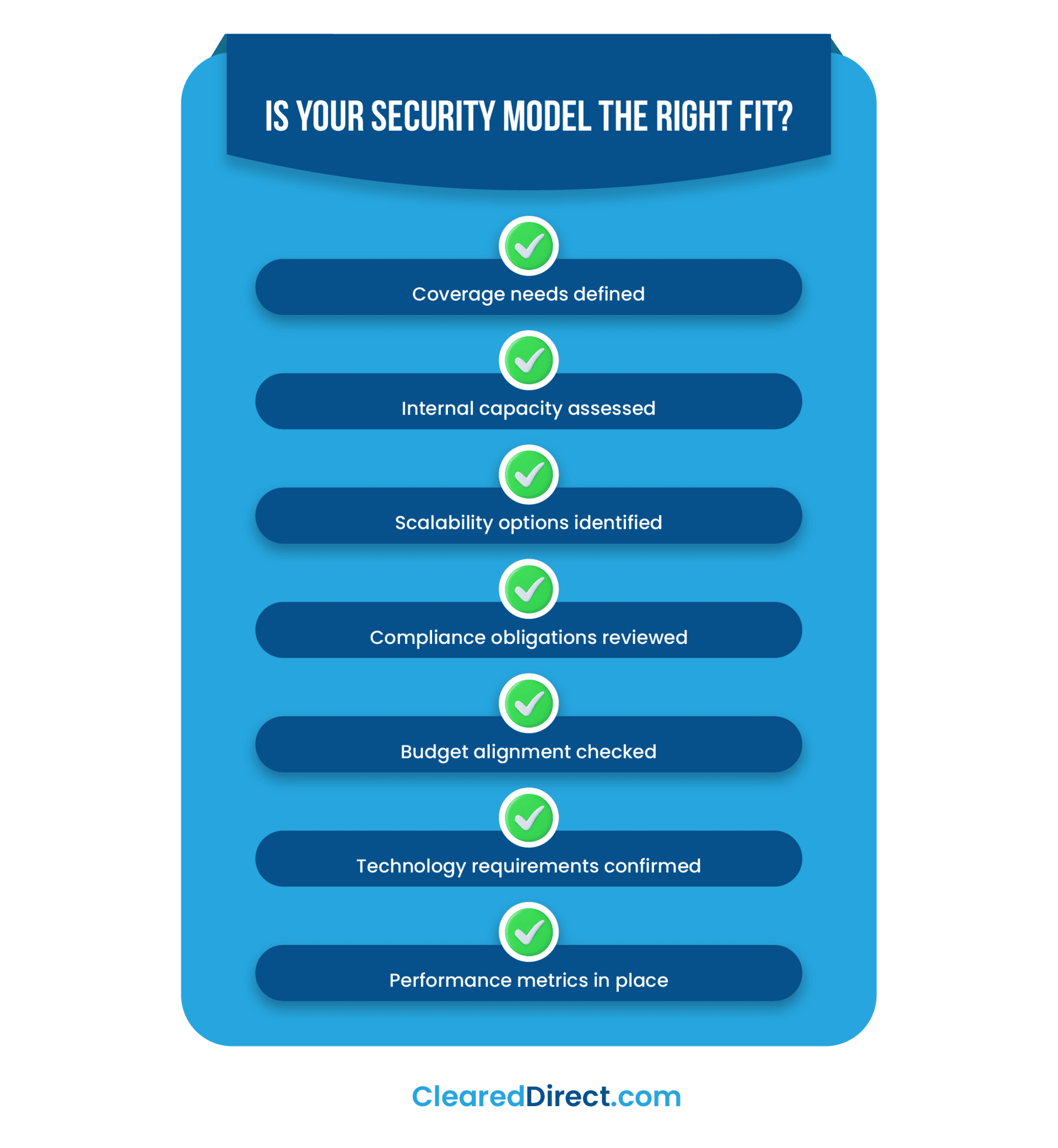
Step 1: Define Your Security Priorities
Identify what matters most for your facility’s protection. This will set the baseline for evaluating whether an in-house or outsourced model is capable of meeting your expectations consistently over time.
- Is constant on-site coverage essential, or will periodic patrols suffice?
- Do you need guards to interact with tenants and visitors daily?
- Is rapid incident response your top priority?
Step 2: Assess Your Internal Capacity
Review your ability to manage a security team effectively. Without the right internal structure, even the most well-trained guards can underperform, so this step is essential before committing to an in-house approach.
- Do you have dedicated HR or operations staff to handle recruitment and training?
- Can your team monitor performance and ensure ongoing compliance?
- Is there a budget set aside for equipment and maintenance?
Step 3: Evaluate Scalability Needs
Consider how often and how quickly coverage requirements change. A model that works for your daily routine may not be able to handle unexpected spikes in activity or demand without careful planning.
- Do you host seasonal events or experience peak operational periods?
- Would you need additional staff at short notice?
- How often do security demands exceed your current resources?
Step 4: Address Compliance Obligations
Ensure your model can meet legal and industry requirements. Failing to keep up with licensing, certifications, or reporting standards can expose your facility to unnecessary risk and potential fines.
- Are you subject to licensing, insurance, or reporting mandates?
- Can your internal team keep pace with changing regulations?
- Do you have processes in place to maintain certifications?
Step 5: Compare Measurable Results
Base your decision on data, not assumptions. A trial or pilot period can reveal operational strengths and weaknesses that may not be obvious from proposals or initial discussions.
- Can you run a trial of each model or a hybrid approach?
- How will you measure effectiveness — incident rates, response times, tenant satisfaction?
- What benchmarks define success for your facility’s security?
Closing
Both in-house and outsourced security can provide strong protection, but the right choice depends on your priorities, resources, and how quickly you need to adapt to changing demands. In-house teams give you control and familiarity, while outsourcing offers scalability, predictable costs, and access to skilled professionals.
If you need proven expertise, you can explore our security services and see the industries and facility types we cover. From high-traffic office complexes to compliance-heavy environments, ClearedDirect provides tailored solutions designed to keep your facility operations secure and running smoothly.
FAQ’s
Facilities with fluctuating coverage needs, strict compliance requirements, or limited internal resources often see the most value in outsourcing. This includes multi-tenant complexes, event venues, and sites that require rapid scalability.
In-house security is staffed, trained, and managed entirely by your organization. Outsourcing involves hiring a third-party provider to supply and manage security personnel, equipment, and compliance. The main differences are who employs the staff, who manages day-to-day operations, and how costs are structured.
The better option depends on your priorities. Choose in-house if full control, staff familiarity, and direct management are critical to your operations. Opt for outsourcing if you need cost predictability, quick scalability, or access to specialized expertise without building it internally. Many facilities use a hybrid model, combining the strengths of both approaches to maintain flexibility while ensuring consistent coverage and high service standards year-round.
In-house means the service is handled entirely by your own employees and resources. “Outsourcing” means contracting an external provider to deliver the service, with the provider managing its staff, processes, and tools.
In many cases, yes. Outsourcing consolidates costs for staffing, training, equipment, and insurance into a single fee, which can be lower than managing these expenses separately. However, the actual savings depend on your facility’s size, coverage requirements, and internal capacity to manage a team effectively.
References:
https://advanceosps.com/2023/12/security-guard-services-in-house-or-outsourced
https://maservicesgroup.com.au/blog/security/in-house-security-vs-outsourcing-security
Tags:

Kevin Milewski
Kevin Milewski is the Chief Operating Officer at ClearedDirect, where he oversees operational strategy, technology implementation, and service delivery for aviation and commercial drone (UAV) projects. With a strong background in aviation services and facility management, Kevin focuses on improving safety, efficiency, and regulatory compliance across complex airport and industrial environments. At ClearedDirect, Kevin leads initiatives integrating drone surveillance, LiDAR imaging, and AI-driven facility inspection systems that help clients achieve higher safety and performance standards. His leadership contributes to the company’s commitment to precision, reliability, and data-driven decision-making in critical infrastructure operations. Kevin regularly contributes insights to ClearedDirect’s knowledge hub, covering UAV surveillance, aviation operations, and facility optimization topics. His work reflects practical industry experience and a dedication to advancing innovation in aviation and technology management. Connect with Kevin on LinkedIn to learn more about his work.
RECENT POSTS


Recent Comments
CATEGORIES
- Aviation Facility Management
- Commercial Cleaning
- Construction
- Digital Mapping & Analytics
- Drone & LiDAR Inspections
- Drone And LiDAR Guides
- Facility Cleaning Resources
- Facility Management Guides
- Facility Management Risk
- Facility Management Technology
- Facility Operations
- Facility Security Management
- Identifying & Eliminating Inefficiencies
- Operations Management Guides
- Process Optimization
- Security Management Guides
- Staffing Augmentation Guides
- Surveillance UAV Drone Guides
- UAV Drone Mapping
- Uncategorized
TAGS
2025 facility trends aerial surveillance aircraft cleaning airline operations airport compliance management airport operational risk management airport personnel airport terminal operations Aviation Operations Aviation Risk Management aviation security risk assessment aviation services AviationStaffing aviation staffing Commercial Cleaning Services Commercial Drone Surveillance Commercial Facility Security Drone Surveying Emergency Response Planning Facility Hygiene Compliance facility maintenance facility management Facility Risk Assessment Facility risk management facility services Green Cleaning for Facilities ground handling services integrated facility management services Operational Efficiency Strategies operations management outsource facility management outsourcing airline services outsourcing airport services passenger experience enhancement Physical Security Best Practices proactive maintenance Scaling janitorial operations seasonal peaks staff augmentation Staffing Augmentation Staffing Challenges Aviation terminal facility security TSA FAA risk mitigation uav infrastructure inspection uav lidar technology
Leave a Comment